The Chinese Journal of Process Engineering >
Controllable preparation process of gas core double emulsion droplets via synergistic effect of backpressure and capillary number
Received date: 2025-12-09
Revised date: 2026-02-11
Online published: 2026-09-28
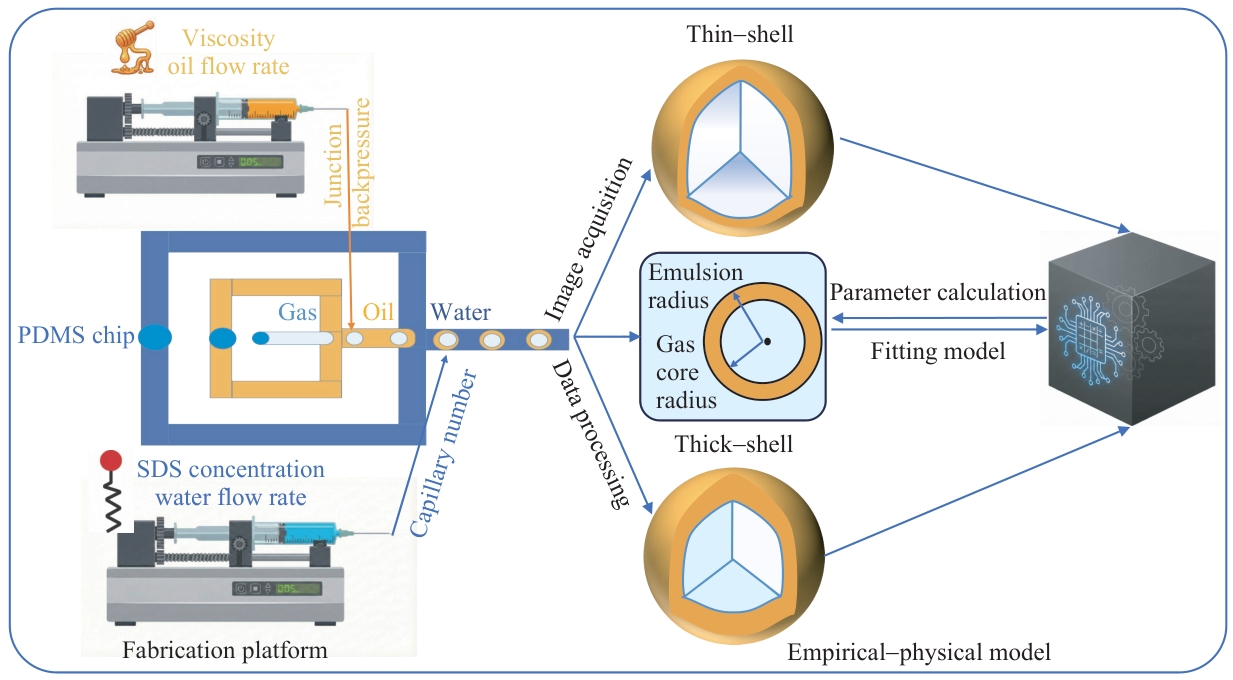
Gas core double emulsions serve as critical precursors for fabricating high-performance hollow microcapsules; however, precise control over their geometric characteristics remains a significant challenge due to the compressibility of the gas core and the complexity of multiphase interactions. To address issues of unstable encapsulation and the difficulty in independent dimension control, this study systematically investigates the controllable preparation of gas-oil-water emulsions under constant gas pressure using a dual flow-focusing microfluidic device. The research focuses on establishing a robust process strategy by manipulating key operating parameters, including oil phase viscosity, flow rates, and surfactant concentration. The experimental results demonstrate that the droplet formation process is governed by a distinct coupling mechanism involving the capillary number and junction backpressure. Increasing oil phase viscosity and flow rate elevate the backpressure at the flow junction, which effectively compresses the gas core and increases the shell thickness. The outer-phase parameters dominate the droplet breakup dynamics. By adjusting the surfactant concentration to alter interfacial tension, the overall droplet size can be tuned independently of the core size. Furthermore, based on the experimental data, a dimensionless empirical-physical model is developed to quantitatively predict the shell-to-radius ratio. This model functions as an effective inverse-design tool, enabling the reverse calculation of required flow conditions to achieve a target morphology. This work clarifies the fluid dynamic mechanisms from a process engineering perspective, providing theoretical guidance and a practical basis for the programmable and controllable fabrication of hollow microcapsules with specific structural characteristics.
Jianhao ZHAO , Dongxiang WANG , Fangyang YUAN , Xinjun YANG , Jiyun DU , Wei YU . Controllable preparation process of gas core double emulsion droplets via synergistic effect of backpressure and capillary number[J]. The Chinese Journal of Process Engineering, 2026 , 26(9) : 987 -997 . DOI: 10.12034/j.issn.1009-606X.225306
| [1] | Choudhury N, Meghwal M, Das K. Microencapsulation: an overview on concepts, methods and applications [J]. Food Frontiers, 2021, 2(3): 327-344. |
| [2] | Silva B F B, Rodríguez-Abreu C, Vilanova N. Recent advances in multiple emulsions and their application as templates [J]. Current Opinion in Colloid & Interface Science, 2016, 25: 98-108. |
| [3] | Zhu J Y, He J Y, Zhou J, et al. Recent progress in microencapsulation technology and its applications in petroleum industry [J]. Journal of Molecular Liquids, 2024, 407: 125162. |
| [4] | Molley T G, Jiang S, Ong L, et al. Gas-modulating microcapsules for spatiotemporal control of hypoxia [J]. Proceedings of the National Academy of Sciences, 2023, 120(17): e2217557120. |
| [5] | Toprakcioglu Z, Hakala T A, Levin A, et al. Multi-scale microporous silica microcapsules from gas-in-water-in-oil emulsions [J]. Soft Matter, 2020, 16(13): 3082-3087. |
| [6] | Yoon D H, Hasegawa K, Kaneko Y, et al. Formation of polymeric hollow microcapsules and microlenses using gas-in-organic-in-water droplets [J]. Micromachines, 2015, 6(5): 622-633. |
| [7] | Chen R, Dong P F, Xu J H, et al. Controllable microfluidic production of gas-in-oil-in-water emulsions [J]. Lab on a Chip, 2012, 12(20): 3910-3916. |
| [8] | Duran M, Serrano A, Nikulin A, et al. Microcapsule production by droplet microfluidics: a review from the material science approach [J]. Materials & Design, 2022, 223: 111230. |
| [9] | Lobel B T, Baiocco D, Al-Sharabi M, et al. Current challenges in microcapsule designs and microencapsulation processes: a review [J]. ACS Applied Materials & Interfaces, 2024, 16(31): 40326-40355. |
| [10] | Datta S S, Abbaspourrad A, Amstad E, et al. Double emulsion templated solid microcapsules: mechanics and controlled release [J]. Advanced Materials, 2014, 26(14): 2205-2218. |
| [11] | Vladisavljevi? G T, Al Nuumani R, Nabavi S A. Microfluidic production of multiple emulsions [J]. Micromachines, 2017, 8(3): 75. |
| [12] | Yang L, Wang K, Mak S, et al. A novel microfluidic technology for the preparation of gas-in-oil-in-water emulsions [J]. Lab on a Chip, 2013, 13(17): 3351-3354. |
| [13] | Nekouei M, Vanapalli S A. Volume-of-fluid simulations in microfluidic T-junction devices: influence of viscosity ratio on droplet size [J]. Physics of Fluids, 2017, 29(3): 032007. |
| [14] | Utada A S, Lorenceau E, Link D R, et al. Monodisperse double emulsions generated from a microcapillary device [J]. Science, 2005, 308(5721): 537-541. |
| [15] | Yang S H, Song W L, Fan L L, et al. Microfluidic fabrication of monodisperse microcapsules with gas cores [J]. Lab on a Chip, 2024, 24: 3556-3567. |
| [16] | Anna S L. Droplets and bubbles in microfluidic devices [J]. Annual Review of Fluid Mechanics, 2016, 48: 285-309. |
| [17] | Dai Y C, Cha H T, Nguyen N K, et al. Dynamic behaviours of monodisperse double emulsion formation in a tri-axial capillary device [J]. Micromachines, 2022, 13(11): 1877. |
| [18] | Hu C Y, Jiang F, Yan J. Formation of double emulsion droplets in flow-focusing microchips: a numerical parametric study [J]. Journal of Flow Chemistry, 2024, 14: 641-653. |
| [19] | Calhoun S G K, Brower K K, Chandran Suja V, et al. Systematic characterization of effect of flow rates and buffer compositions on double emulsion droplet volumes and stability [J]. Lab on a Chip, 2022, 22: 2315-2330. |
| [20] | Cleve S, Lassus A, Diddens C, et al. Microbubble formation by flow focusing: role of gas and liquid properties, and channel geometry [J]. Journal of Fluid Mechanics, 2023, 972: A27. |
| [21] | He C X, Liu X Y, Dong Y P, et al. Droplet formation in a step-emulsification microdevice: effect of fluid's viscosity [J]. Chemical Engineering and Processing: Process Intensification, 2023, 185: 109309. |
| [22] | Wang S T, Wang H, Wu Y T, et al. Numerical study of double emulsion generation in a flow-focusing microchannel by multiple-relaxation-time lattice Boltzmann method [J]. Physics of Fluids, 2024, 36(3): 032010. |
| [23] | Deng B X, Schro?n K. Dynamic interfacial effects investigated by microfluidics: formation and stability of droplets and bubbles [J]. Current Opinion in Colloid & Interface Science, 2024, 73: 101826. |
| [24] | Huang B, Ge X J, Rubinstein B Y, et al. Gas-assisted microfluidic step-emulsification for generating hollow-core double emulsions [J]. Microsystems & Nanoengineering, 2023, 9: 38. |
| [25] | Wang J W, Hahn S, Amstad E, et al. Tailored double emulsions made simple [J]. Advanced Materials, 2022, 34(5): 2107338. |
| [26] | Xie B S, Jiang F, Lin H J, et al. Numerical investigation of the effect of microfluidic flow parameters and physical properties on double emulsion droplet forming [J]. Meccanica, 2024, 59: 157-168. |
| [27] | Lee D, Shen A Q. Interfacial tension measurements in microfluidic quasi-static extensional flows [J]. Micromachines, 2021, 12(3): 272. |
| [28] | Brosseau Q, Vrignon J, Baret J C. Microfluidic dynamic interfacial tensiometry (μDIT) [J]. Soft Matter, 2014, 10(17): 3066-3076. |
/
| 〈 |
|
〉 |