Loading...
Welcome to visit The Chinese Journal of Process Engineering, Today is

Table of Content

    28 September 2026, Volume 26 Issue 9
    Contents
    Cover and Contents
    The Chinese Journal of Process Engineering. 2026, 26(9):  0. 
    Asbtract ( )   PDF (3855KB) ( )  
    Related Articles | Metrics
    Review
    Research status and prospects of advanced sensing technologies in the sintering process
    Zhengwei YU, Jiaxin HAN, Liangjun CHEN, Weiwen LU, Xinyu ZHANG, Yi YUAN, Hongming LONG
    The Chinese Journal of Process Engineering. 2026, 26(9):  929-947.  DOI: 10.12034/j.issn.1009-606X.225277
    Asbtract ( )   HTML ( )   PDF (5770KB) ( )  
    Figures and Tables | References | Related Articles | Metrics

    (1)The intelligent upgrading of the sintering process is crucial for promoting green and low-carbon transformation, with precise sensing technology as the foundation for intelligent regulation and optimization.

    (2)Recent advances in sintering sensing technologies, which focusing on detection methods for key parameters such as composition, moisture, sintering endpoint, and air leakage rate are reviewed.

    (3)Future sensing systems should enable multi-source fusion and intelligent self-calibration to enhance stability and robustness, advancing the sintering process toward intelligent, green, and efficient operation.

    Research progress on fouling in copper electrolyte pipelines: fouling mechanism and influencing factors
    Xiangjun BAO, Songpeng LU, Lu ZHANG, Shuyou LU, Chun DING, Jialiu LIU
    The Chinese Journal of Process Engineering. 2026, 26(9):  948-958.  DOI: 10.12034/j.issn.1009-606X.225258
    Asbtract ( )   HTML ( )   PDF (15372KB) ( )  
    Figures and Tables | References | Related Articles | Metrics

    (1)The current situation, hazards, and shortcomings of existing research and technologies regarding fouling in copper electrolyte pipelines in the electrolytic copper industry are analyzed and discussed.

    (2)The core mechanisms, key influencing factors of fouling in copper electrolyte pipelines, and the coupling mechanism between boundary layer characteristics and fouling are summarized.

    (3)The challenges in current research on fouling in copper electrolyte pipelines and fouling prevention technologies are pointed out, and future research directions are proposed.

    Research progress on green flotation depressants for pyrite and computational chemistry of microscopic depressing mechanisms
    Dongdong HE, Jian LIU, Rong HUANG, Hong YIN, Puwen FAN
    The Chinese Journal of Process Engineering. 2026, 26(9):  959-975.  DOI: 10.12034/j.issn.1009-606X.225297
    Asbtract ( )   HTML ( )   PDF (7688KB) ( )  
    Figures and Tables | References | Related Articles | Metrics

    (1)The limitations of traditional pyrite depressants and future development trends are introduced.

    (2)The crystal structure and surface properties of pyrite are described.

    (3)The classification and mechanisms of pyrite depressants are summarized.

    (4)The application of computational chemistry in pyrite depression research is compared.

    Research Paper
    Research on heat transfer characteristics and tube layout optimization of indirect electric heating furnace
    Juan WANG, Rui ZHANG, Chunhua JIA, Guanda WANG
    The Chinese Journal of Process Engineering. 2026, 26(9):  976-986.  DOI: 10.12034/j.issn.1009-606X.225326
    Asbtract ( )   HTML ( )   PDF (5205KB) ( )  
    Figures and Tables | References | Related Articles | Metrics

    The shell-and-tube electric heating furnace that uses high-temperature molten salt as an indirect heat carrier to heat thermal oil is a new type of indirect heating furnace that can achieve green zero-carbon emissions from traditional thermal oil furnaces. Based on natural convection and Boussinesq assumption, five different pipe layout methods of molten salt indirect electric heating furnaces are studied by CFD simulation. After comprehensive comparison, the basic configuration of hexagonal tube layout is determined, and the influence of different tube spacing on the heat transfer process inside high-temperature molten salt electric heating furnaces is further analyzed. The results show that, with a square pipe arrangement, at a spacing of 30 mm, the flow resistance of molten salt is high, resulting in low heat transfer efficiency, and the outlet temperature is 315.3℃. When the tube spacing is increased to 40 mm, the flow resistance decreases and heat transfer reaches its maximum, yielding the maximum outlet temperature of 315.7℃. This configuration is suitable for designs with small area and low requirement on temperature uniformity. In the case of a rectangular pipe arrangement, as the pipe spacing increases, the flow space of molten salt expands, the heat flow disturbance is reduced, and the natural convection loop becomes more complete. The highest outlet temperature is achieved with a tube spacing of 50 mm. However, as the spacing continues to increase, the heat flow concentration decreases, and the heat transfer efficiency is reduced. A pipe spacing of 50 mm in the rectangular arrangement is suitable for designs requiring larger flow spaces and higher heat transfer efficiency.

    Controllable preparation process of gas core double emulsion droplets via synergistic effect of backpressure and capillary number
    Jianhao ZHAO, Dongxiang WANG, Fangyang YUAN, Xinjun YANG, Jiyun DU, Wei YU
    The Chinese Journal of Process Engineering. 2026, 26(9):  987-997.  DOI: 10.12034/j.issn.1009-606X.225306
    Asbtract ( )   HTML ( )   PDF (25567KB) ( )  
    Figures and Tables | References | Related Articles | Metrics

    Gas core double emulsions serve as critical precursors for fabricating high-performance hollow microcapsules; however, precise control over their geometric characteristics remains a significant challenge due to the compressibility of the gas core and the complexity of multiphase interactions. To address issues of unstable encapsulation and the difficulty in independent dimension control, this study systematically investigates the controllable preparation of gas-oil-water emulsions under constant gas pressure using a dual flow-focusing microfluidic device. The research focuses on establishing a robust process strategy by manipulating key operating parameters, including oil phase viscosity, flow rates, and surfactant concentration. The experimental results demonstrate that the droplet formation process is governed by a distinct coupling mechanism involving the capillary number and junction backpressure. Increasing oil phase viscosity and flow rate elevate the backpressure at the flow junction, which effectively compresses the gas core and increases the shell thickness. The outer-phase parameters dominate the droplet breakup dynamics. By adjusting the surfactant concentration to alter interfacial tension, the overall droplet size can be tuned independently of the core size. Furthermore, based on the experimental data, a dimensionless empirical-physical model is developed to quantitatively predict the shell-to-radius ratio. This model functions as an effective inverse-design tool, enabling the reverse calculation of required flow conditions to achieve a target morphology. This work clarifies the fluid dynamic mechanisms from a process engineering perspective, providing theoretical guidance and a practical basis for the programmable and controllable fabrication of hollow microcapsules with specific structural characteristics.

    Molecular dynamics simulation of effects of nano-Al2O3 particle size and doping content on properties of cellulose
    Yuzhen LI Yuqi LIU Wei CHEN Ying REN Jinze DAI Qingang XIONG
    The Chinese Journal of Process Engineering. 2026, 26(9):  998-1006.  DOI: 10.12034/j.issn.1009-606X.226022
    Asbtract ( )   HTML ( )   PDF (5103KB) ( )  
    Related Articles | Metrics
    This study employs molecular dynamics (MD) simulations to address the performance limitations of traditional cellulose insulating paper. Hydroxylated Al2O3 nanoparticle models are constructed to systematically investigate the effects of Al2O3 nanoparticles (0.5 nm, 0.9 nm; 0wt%~7wt% doping content) on the mechanical properties, hydrogen bond interactions, and free volume of cellulose insulating paper. The results demonstrate that the Young's modulus, shear modulus, and bulk modulus of the nanocomposite system all exhibit a distinct trend of initial increase followed by a decrease as the doping content rises. The internal hydrogen bond density of the system varies synchronously with the mechanical properties, while the potential energy of the cellulose single chains shows an opposite trend, first decreasing and then increasing. Furthermore, the fraction free volume (FFV) initially decreases and subsequently increases with increasing doping content, displaying a significant negative correlation with the mechanical performance of the modified system. 3wt% is identified as the optimal doping content, and the 0.9 nm particle size achieves a superior modification effect. Mechanistic analysis reveals that the intermolecular interactions within the cellulose matrix serve as the dominant factor regulating the mechanical properties of the composite. At low doping contents, the thermodynamic and structural stability of the cellulose is effectively enhanced through the synergistic effects of physical filling, hydrogen bond formation, and van der Waals forces between the Al2O3 nanoparticles and the cellulose molecular chains. Conversely, excessive doping leads to nanoparticle agglomeration within the cellulose matrix, which causes the failure of the nanomodification. This agglomeration induces an abnormal increase in the system's free volume and ultimately leads to significant degradation in the performance of the modified insulating paper. With the calculation and discussion of mechanical properties, molecular structures, and the underlying mechanisms, this study provides a theoretical foundation for the optimization of insulating paper for ultra-high-voltage transformers.
    Interaction effects analysis and process parameter optimization for gel breaking of waste drilling fluid
    Yihan LI, Zhixiao LI, Xiaodong GE, Kexian HU, Zhengping WAN, Zheng FAN
    The Chinese Journal of Process Engineering. 2026, 26(9):  1007-1020.  DOI: 10.12034/j.issn.1009-606X.225312
    Asbtract ( )   HTML ( )   PDF (4966KB) ( )  
    Figures and Tables | References | Related Articles | Metrics

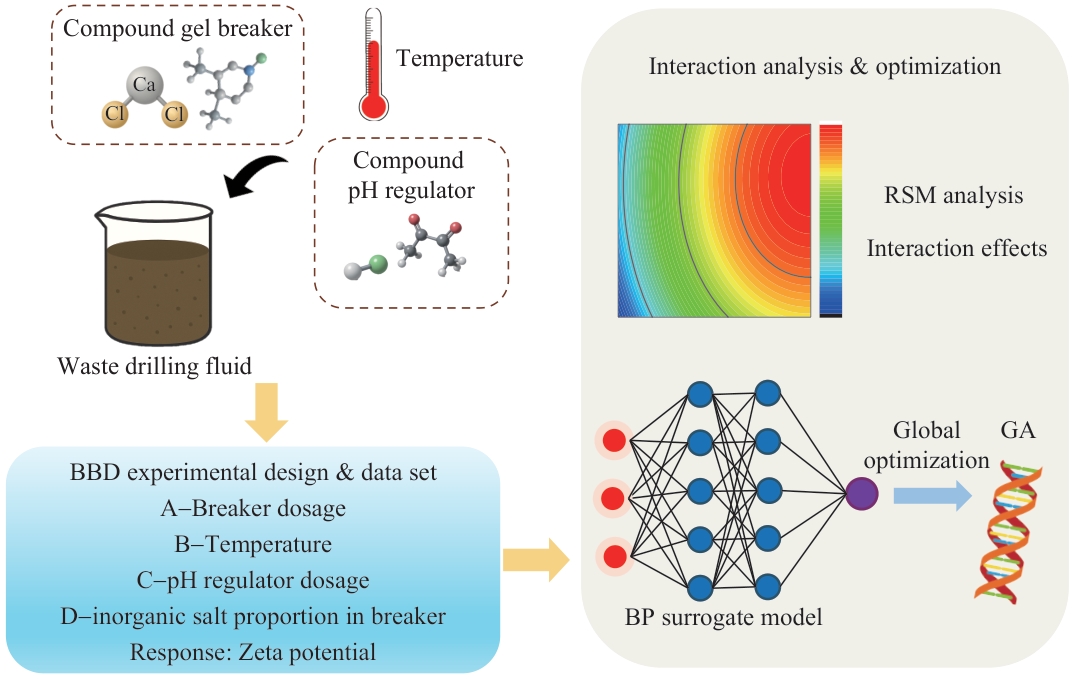
    Waste drilling fluids are difficult to reuse because they are strongly alkaline and remain highly stable as dispersed colloidal systems, which hinders solid-liquid separation. Therefore, gel breaking and destabilization are required before reuse. The destabilization efficiency is controlled by multiple operating conditions, among which breaker dosage, reaction temperature, pH regulator dosage, and inorganic salt proportion are critical. In this study, the Zeta potential of the treated drilling fluid was used as the stability indicator because it sensitively reflected changes in particle aggregation and dispersion. Based on experimental data obtained from a Box-Behnken design (BBD), response surface methodology (RSM) combined with analysis of variance (ANOVA) was employed to assess the significance of main effects and interactions among factors. Building on these results, three surrogate models—a backpropagation neural network (BP-ANN), random forest regression (RF), and Gaussian process regression (GPR)—were constructed to predict and compare the performance of Zeta potential modeling. Results indicated that the BP neural network achieved optimal fitting performance, with an overall coefficient of determination (R2) of 0.9629 and an average R2 of 0.8125 under 5-fold cross-validation—significantly higher than those of other surrogate models. Thus, it was selected as the process optimization model. To further identify the optimal solution, a genetic algorithm (GA) was integrated with BP-ANN for global optimization. The GA-BP method yielded optimal parameters: gel breaker dosage of 3.306 g/L, reaction temperature of 57.74℃, pH adjuster dosage of 3.45 g/L, an inorganic salt proportion of 0.80, and a predicted Zeta potential of -10.735 mV. The measured value was -10.85 mV, with a relative error of 1.06%. Overall, the proposed experimental design-based modeling and optimization framework provides a reliable basis for determining operating parameters for gel breaking and destabilization, and supports the subsequent reuse of treated drilling fluids.

    Mechanism study on efficient leaching of chalcopyrite by ammonium carbonate
    Heyun SUN, Renman RUAN, Jiushuai DENG, Xiaopeng NIU
    The Chinese Journal of Process Engineering. 2026, 26(9):  1021-1030.  DOI: 10.12034/j.issn.1009-606X.225308
    Asbtract ( )   HTML ( )   PDF (7308KB) ( )  
    Figures and Tables | References | Related Articles | Metrics

    Intermediate iron oxides and other products formed during the ammonia leaching of chalcopyrite are considered primary causes of passivation and restricting leaching efficiency, making them a persistent research focus in this field. To elucidate why the leaching rate of chalcopyrite in the (NH4)2CO3 system is significantly higher than in other ammonium salt systems, this work systematically investigates the kinetic behavior and reaction mechanism of chalcopyrite leaching by (NH4)2CO3 under low-oxygen conditions using a sealed magnetic stirring apparatus. The results demonstrate that (NH4)2CO3 can efficiently leach chalcopyrite, the copper extraction efficiency reaches 89.67%. Through various characterization techniques including scanning electron microscopy-energy dispersive X-ray spectroscopy (SEM-EDS), X-ray diffraction (XRD), Raman spectroscopy, and thermogravimetry-differential scanning calorimetry (TG-DSC), the intermediate product formed during the (NH4)2CO3 leaching process is identified as (NH4)2Fe2(OH)4(CO3)2·H2O. This intermediate product partially disperses in the leaching solution and partially deposits on the chalcopyrite surface in a loose, porous morphology, exerting minimal influence on leaching kinetics. Thermodynamic calculations and solution chemistry experiments confirmed that Fe2+ oxidized and dissolved from the chalcopyrite surface can form stable soluble complexes with CO32- in solution, and subsequently generate needle-shaped (NH4)2Fe2(OH)4(CO3)2·H2O intermediate products under the action of NH4+ and OH-. Under aerobic conditions, this intermediate further transforms into iron oxides such as hematite with the same crystal structure. This study identifies a new iron intermediate product and its formation and transformation pathways during the ammonia leaching of chalcopyrite, reveals a novel mechanism for the efficient leaching of chalcopyrite by (NH4)2CO3, refines the understanding of chalcopyrite ammonia leaching mechanisms, and provides important theoretical support for the industrial application of this system.

    Evolution of bubbles in dissociated water and their enhancement mechanism for hydrate reformation
    Siyang LI, Yujie ZHU, Yuzhou CHEN, Kang LIU, Peng XIAO, Changyu SUN
    The Chinese Journal of Process Engineering. 2026, 26(9):  1031-1041.  DOI: 10.12034/j.issn.1009-606X.225304
    Asbtract ( )   HTML ( )   PDF (12014KB) ( )  
    Figures and Tables | References | Related Articles | Metrics

    Although depressurization is one of the most promising methods for natural gas hydrate extraction, it carries the risk of hydrate reformation within hydrate-bearing sediments and wellbores during hydrate extraction. This study investigated the formation and evolution of bubbles in water from hydrate dissociation and their effects on hydrate reformation. The results suggested that the hydrate dissociation process was accompanied by the generation of a significant number of bubbles, whereas methane-saturated water without prior hydrate formation did not produce bubbles after the same depressurization process. An increase in the dissociation pressure led to a higher number of bubbles in the dissociation water, a substantial proportion of which had diameters smaller than 5 μm. Under static conditions, bubbles in the dissociation water exhibited phenomena such as coalescence and size increase; however, the overall bubble population remained relatively stable. The presence of bubbles was found to promote hydrate reformation by providing nucleation sites and enhancing mass transfer. In the dissociation water that dissociated at 3 MPa, the water conversion efficiency during the reformation process increased by approximately 12% compared to that at atmospheric pressure. Furthermore, a higher reformation pressure resulted in a higher equilibrium water conversion. During hydrate reformation on the bubble surfaces, the bubbles underwent concave deformation, became translucent, and eventually, the encapsulated gas was completely converted into hydrates. Compared to pure water, the existence of sodium dodecyl sulfate (SDS) could significantly accelerate the hydrate formation. The resulting hydrate film exhibited a loose and porous structure, which thereby reduced mass transfer resistance. These findings not only confirm that microbubbles in the dissociation water are a critical factor affecting hydrate reformation but also provide theoretical support for controlling hydrate reformation during depressurization-based extraction.

    Simulation on thermoelectric cooling battery thermal management system considering non-uniform heat generation of lithium-ion battery
    Huimin YU, Huaxia YAN, Yi CHEN, Qiuhua TAO, Huarong ZHENG
    The Chinese Journal of Process Engineering. 2026, 26(9):  1042-1050.  DOI: 10.12034/j.issn.1009-606X.225287
    Asbtract ( )   HTML ( )   PDF (5725KB) ( )  
    Figures and Tables | References | Related Articles | Metrics

    Understanding the thermal physical properties and heat generation distribution patterns of lithium batteries is crucial for designing, modeling, and evaluating the performance of battery thermal management systems. The complex internal structure of lithium batteries leads to non-uniform heat generation. During charging and discharging processes, significant temperature gradients occur between the core and surface of cylindrical batteries, as well as along the axial direction. Although the current majority of simulations of battery thermal behavior assume a uniform volumetric heat source, this simplification inevitably introduces errors and compromises the accuracy of analytical and simulation models. Moreover, in thermoelectric cooling-based battery thermal management systems, the temperature differential across the batteries often approaches the thermal design limit more readily than the maximum temperature itself—further underscoring the importance of developing and applying non-uniform heat generation models for batteries. To address this issue, this study divided a single 18650 battery into five regions. Pulse discharge tests were conducted to obtain surface temperature data for each region and ambient temperature data during discharge at each 10% state of charge (SOC) interval. The heat generation rate of each battery region was calculated, and a non-uniform heat generation model of the single battery in both time and space was established using Fluent software. The results showed that the maximum error between the simulated data and experimental data at each measurement point was 1.28℃. Furthermore, a thermoelectric battery thermal management system model considering the non-uniform heat generation of lithium batteries was proposed. Simulation results indicated that, compared with model using uniform heat generation, the average errors of the maximum temperature and the maximum temperature difference of the proposed model were reduced by 69% and 43%, respectively. The model established in this work offers advantages such as short computation time, low complexity, and high accuracy, aiding in effectively predicting thermal-runaway risks and designing battery thermal management systems.