

过程工程学报 ›› 2026, Vol. 26 ›› Issue (9): 976-986.DOI: 10.12034/j.issn.1009-606X.225326
王娟1( ), 张瑞1, 贾春桦2, 王冠达1
收稿日期:2025-12-25
修回日期:2026-02-28
出版日期:2026-04-08
发布日期:2026-09-28
通讯作者:
王娟 wangjuan@cup.edu.cn
作者简介:王娟,副教授,研究方向为石油化工装备多相流动与燃烧优化,E-mail: wangjuan@cup.edu.cn
基金资助:
Juan WANG1(), Rui ZHANG1, Chunhua JIA2, Guanda WANG1
Received:2025-12-25
Revised:2026-02-28
Online:2026-04-08
Published:2026-09-28
Contact:
Juan WANG wangjuan@cup.edu.cn
摘要:
高温熔盐作为间接载热体加热导热油的管壳式电加热炉是一种新型间接加热炉,可以实现传统导热油炉的绿色零碳排放。本工作基于自然对流和Boussinesq假设,通过CFD模拟研究了熔盐间接电加热炉的5种布管方式,经过综合对比确定了六边形布管的基本构型,进一步分析了不同布管间距对高温熔盐电加热炉内传热过程的影响规律。结果表明,局部电加热管正方形布管情况下,间距30 mm下,熔盐流动阻力大,传热效率低,出口温度315.3℃;管间距升至40 mm时,阻力降低且换热最强,出口温度最高315.7℃,适合小面积、均匀性要求较低的设计。局部电加热管长方形布管情况下,随着管间距增加,熔盐的流动空间变大,热流干扰减弱,自然对流循环更完整,管间距50 mm时出口温度最高;管间距继续增大时,热流聚集程度下降,热量传递效率降低;50 mm的管间距长方形排布方案适合需要较大流动空间和热量传递效率的设计。
中图分类号:
王娟, 张瑞, 贾春桦, 王冠达. 间接电加热炉传热特性及布管优化研究[J]. 过程工程学报, 2026, 26(9): 976-986.
Juan WANG, Rui ZHANG, Chunhua JIA, Guanda WANG. Research on heat transfer characteristics and tube layout optimization of indirect electric heating furnace[J]. The Chinese Journal of Process Engineering, 2026, 26(9): 976-986.
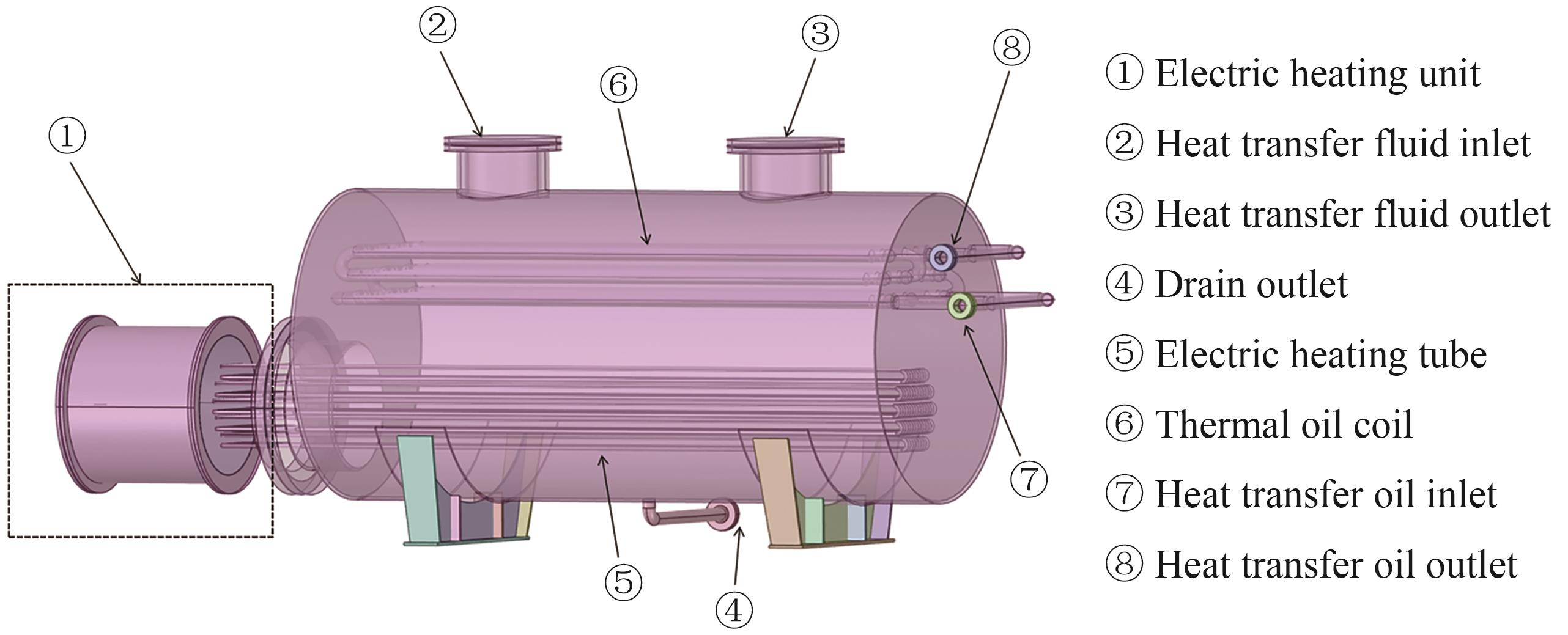
图1 熔盐间接电加热炉结构示意图
Fig.1 Schematic diagram of molten salt indirect electric heating furnace
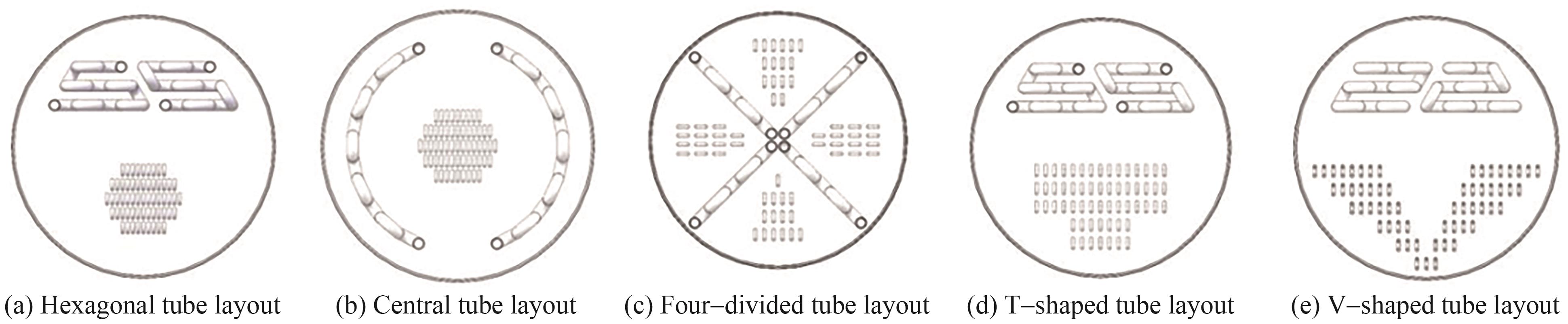
图2 电加热管布管方式示意图
Fig.2 Layout diagrams of electric heating tube
| Thermal physical property | Equation | Temperature range/℃ |
|---|---|---|
| Density/(kg/m3) | -0.748T+2092 | 200~550 |
| Specific heat capacity/[J/(kg·K)] | -0.634T+1655 | 200~550 |
| Thermal conductivity/[W/(m·K)] | -2.5×10⁻⁴T+0.469 | 200~550 |
| Viscosity/[kg/(m·s)] | -2.0×10⁻¹²T3+2.1×10⁻⁹T2-7.1×10⁻⁴T+0.0836 | 200~550 |
表1 熔盐热物性拟合方程
Table 1 Fitting equations for molten salt thermal physical properties
| Thermal physical property | Equation | Temperature range/℃ |
|---|---|---|
| Density/(kg/m3) | -0.748T+2092 | 200~550 |
| Specific heat capacity/[J/(kg·K)] | -0.634T+1655 | 200~550 |
| Thermal conductivity/[W/(m·K)] | -2.5×10⁻⁴T+0.469 | 200~550 |
| Viscosity/[kg/(m·s)] | -2.0×10⁻¹²T3+2.1×10⁻⁹T2-7.1×10⁻⁴T+0.0836 | 200~550 |
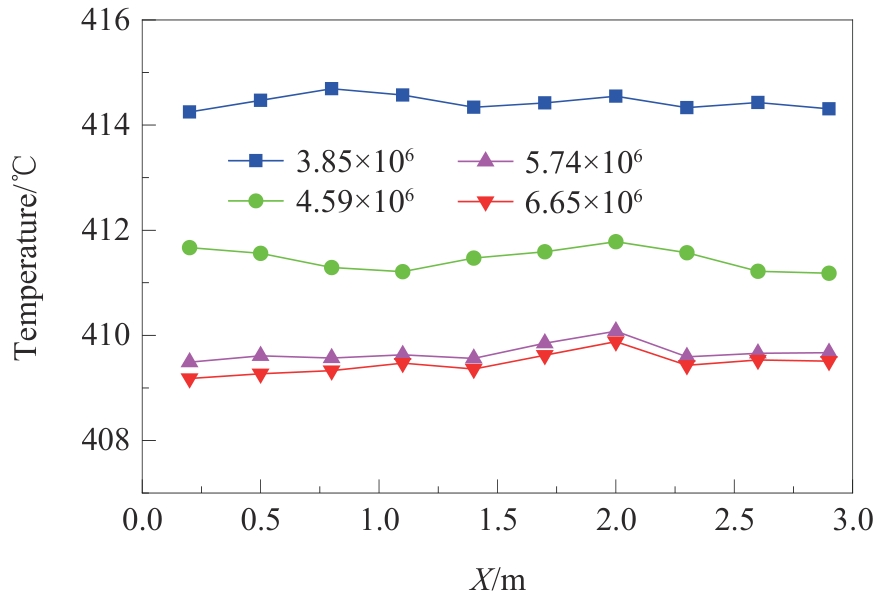
图3 不同网格数量下炉内Y-Z截面平均温度
Fig.3 Average temperature of Y-Z sections in the furnace under different number of grids
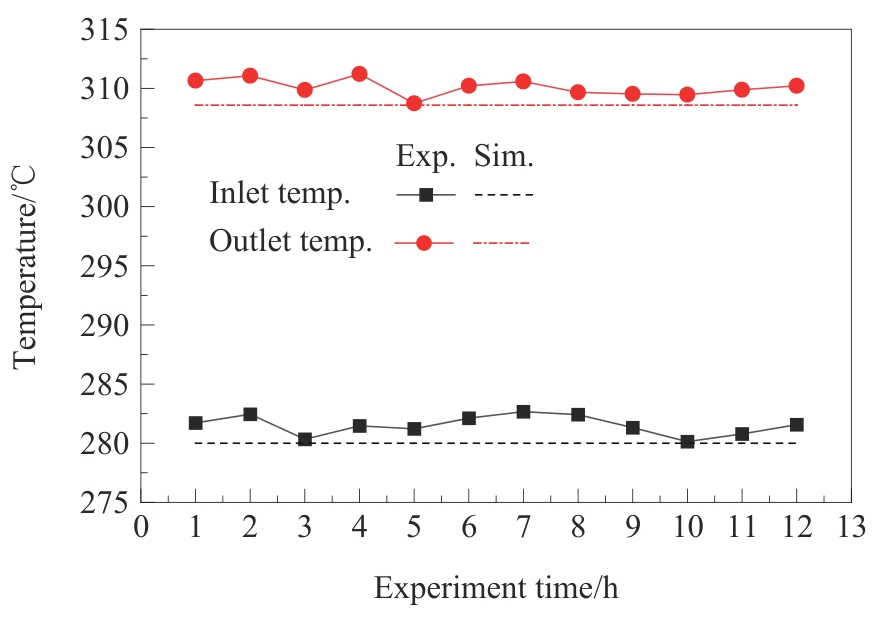
图4 进出口导热油温度的实验结果与模拟结果的对比
Fig.4 Comparison of experimental and simulated temperature of thermal oil at inlet and outlet
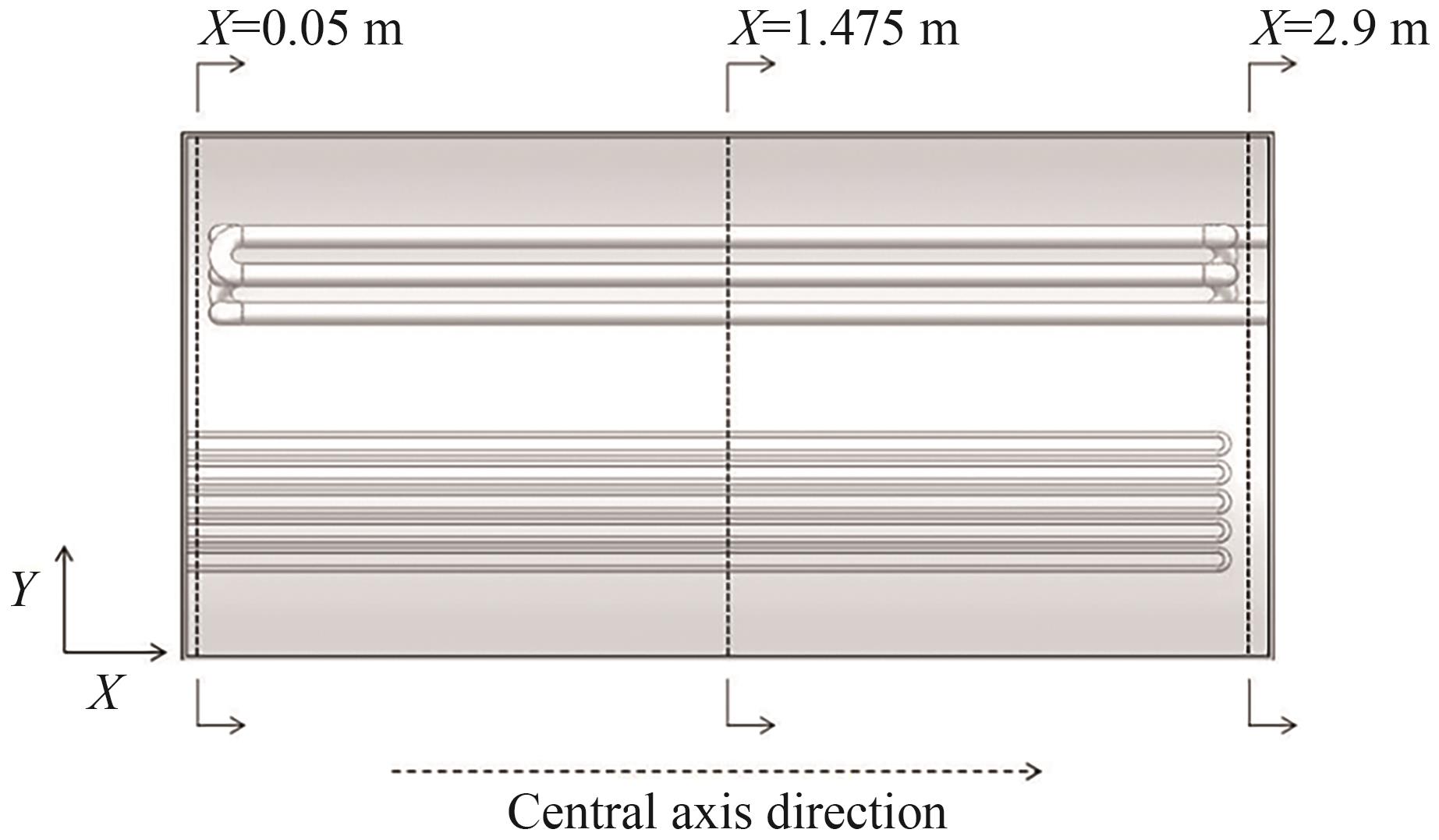
图5 截面示意图
Fig.5 Schematic diagram of cross-sections
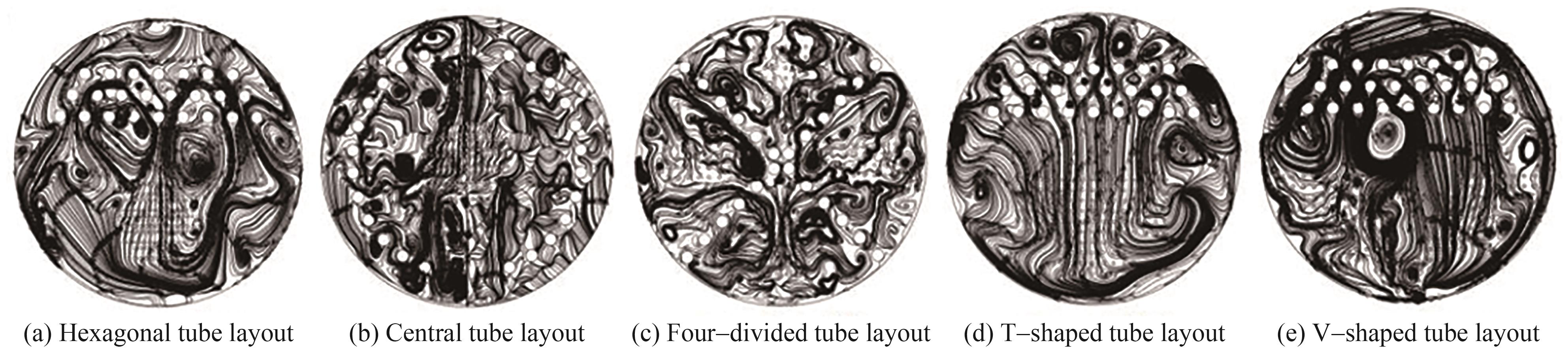
图6 不同加热管布管方式Y-Z截面的速度流线图
Fig.6 Velocity flow diagrams for Y-Z sections of different layouts of heating tubes
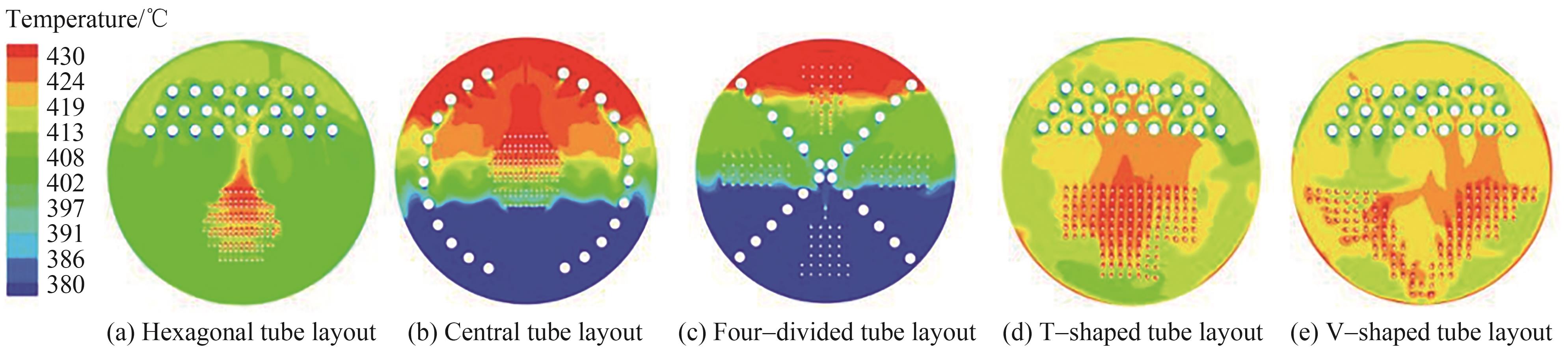
图7 不同布管方式Y-Z截面温度分布
Fig.7 Temperature distribution of Y-Z sections of different layouts of heating tubes
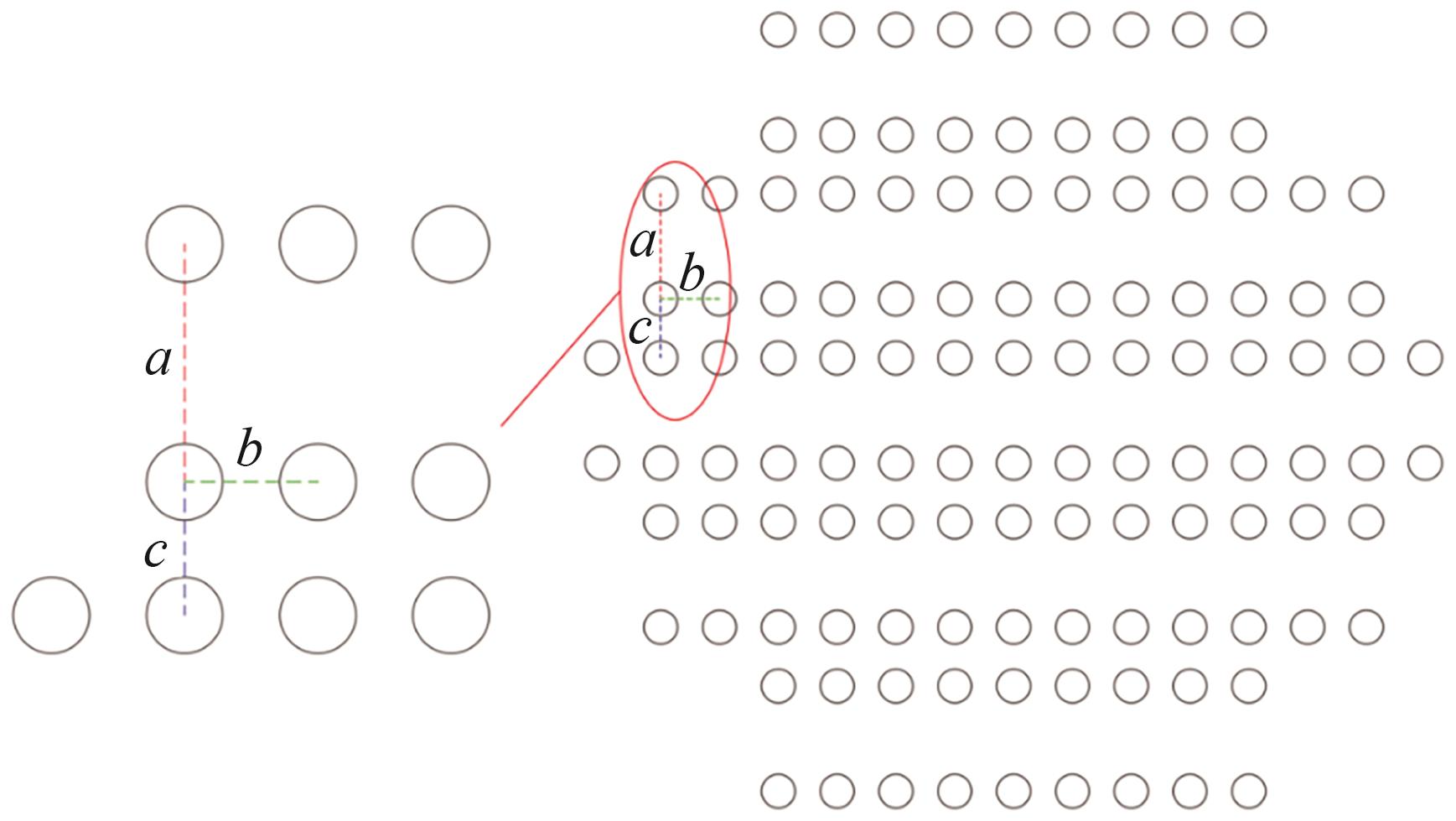
图8 电加热管布管示意图
Fig.8 Layout schematic diagram of electric heating tube
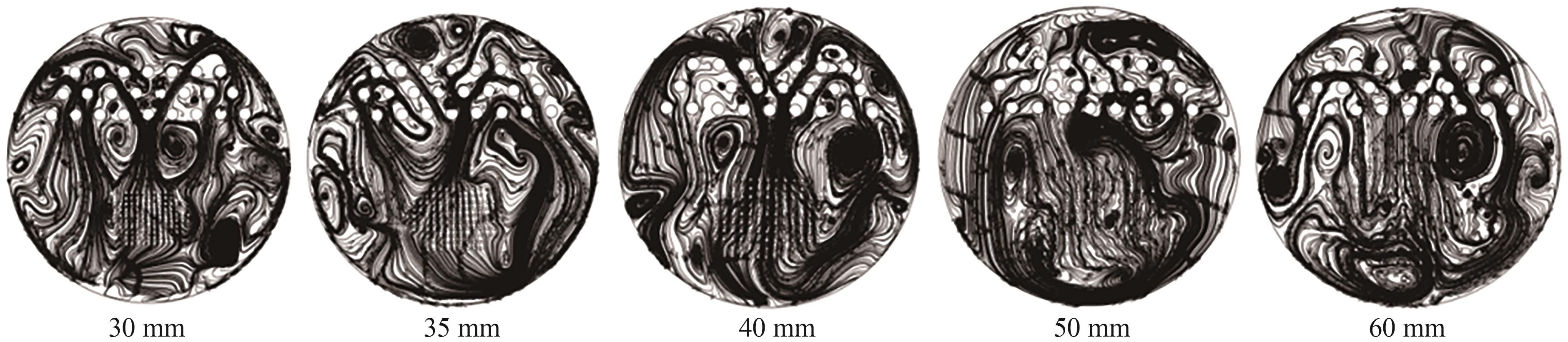
图9 正方形排布下不同管间距b和c时的Y-Z截面的速度流线图
Fig.9 Velocity flow diagrams of Y-Z sections with different tube spacings b and c in square arrangement
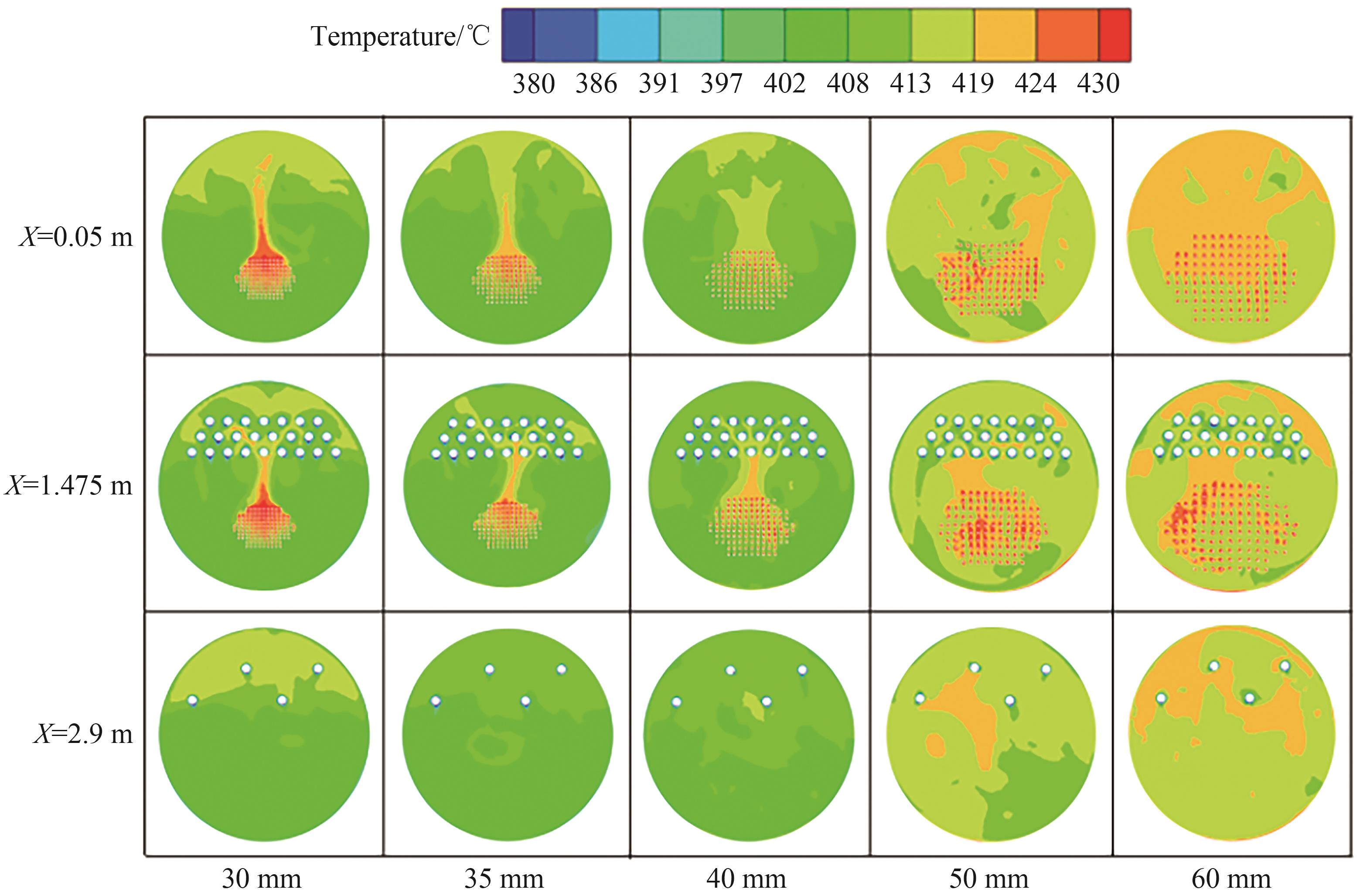
图10 正方形排布下不同管间距b和c时的截面温度分布
Fig.10 Section temperature distributions of different tube spacings b and c in square arrangement
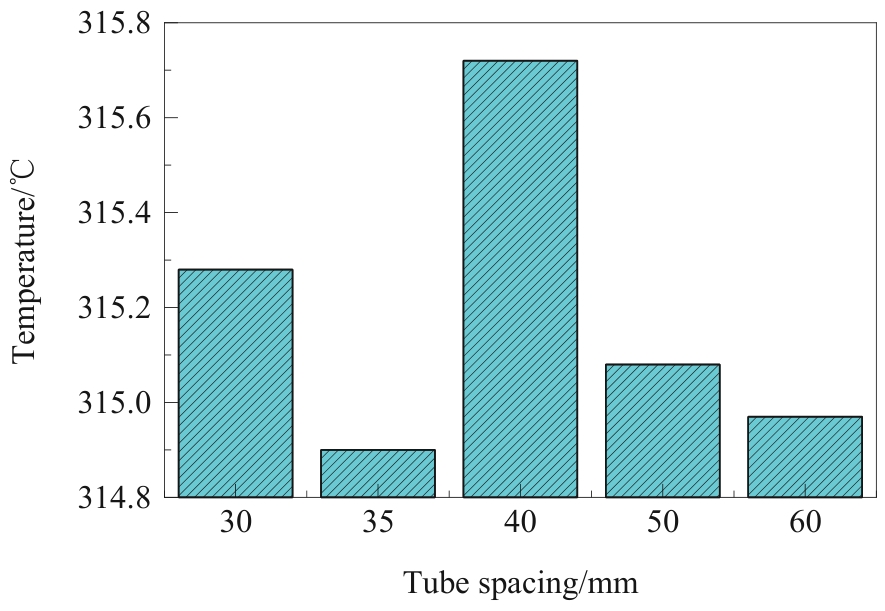
图11 正方形排布下不同管间距b和c时的导热油出口温度
Fig.11 Outlet temperature of thermal oil with different tube spacings b and c in square arrangement
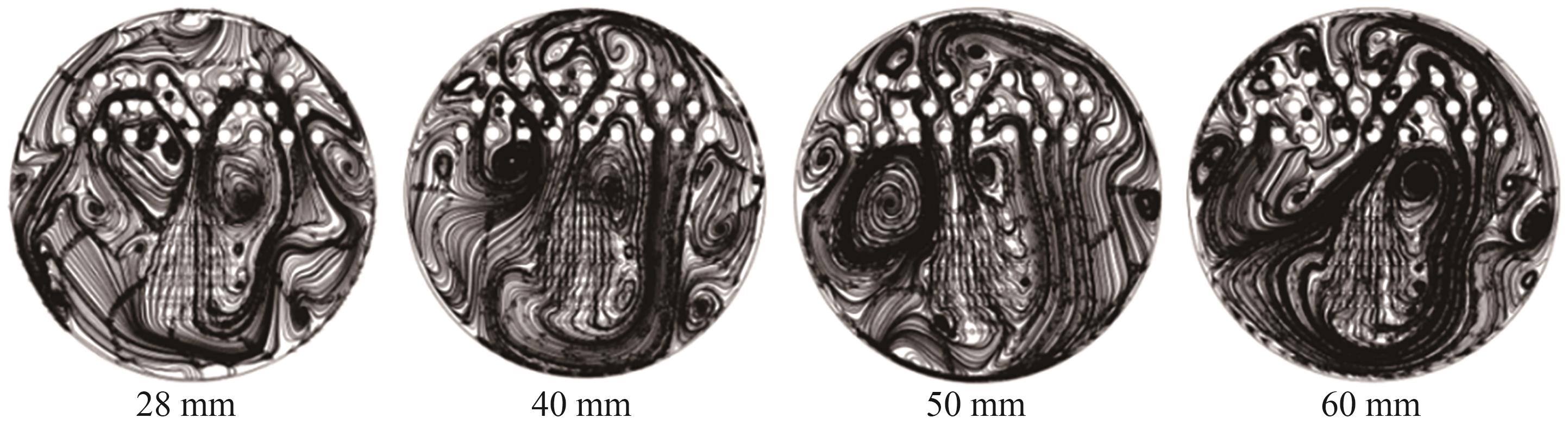
图12 长方形排布下不同管间距a时的Y-Z截面的速度流线图
Fig.12 Velocity flow diagrams of Y-Z sections with different tube spacings a in rectangular arrangement
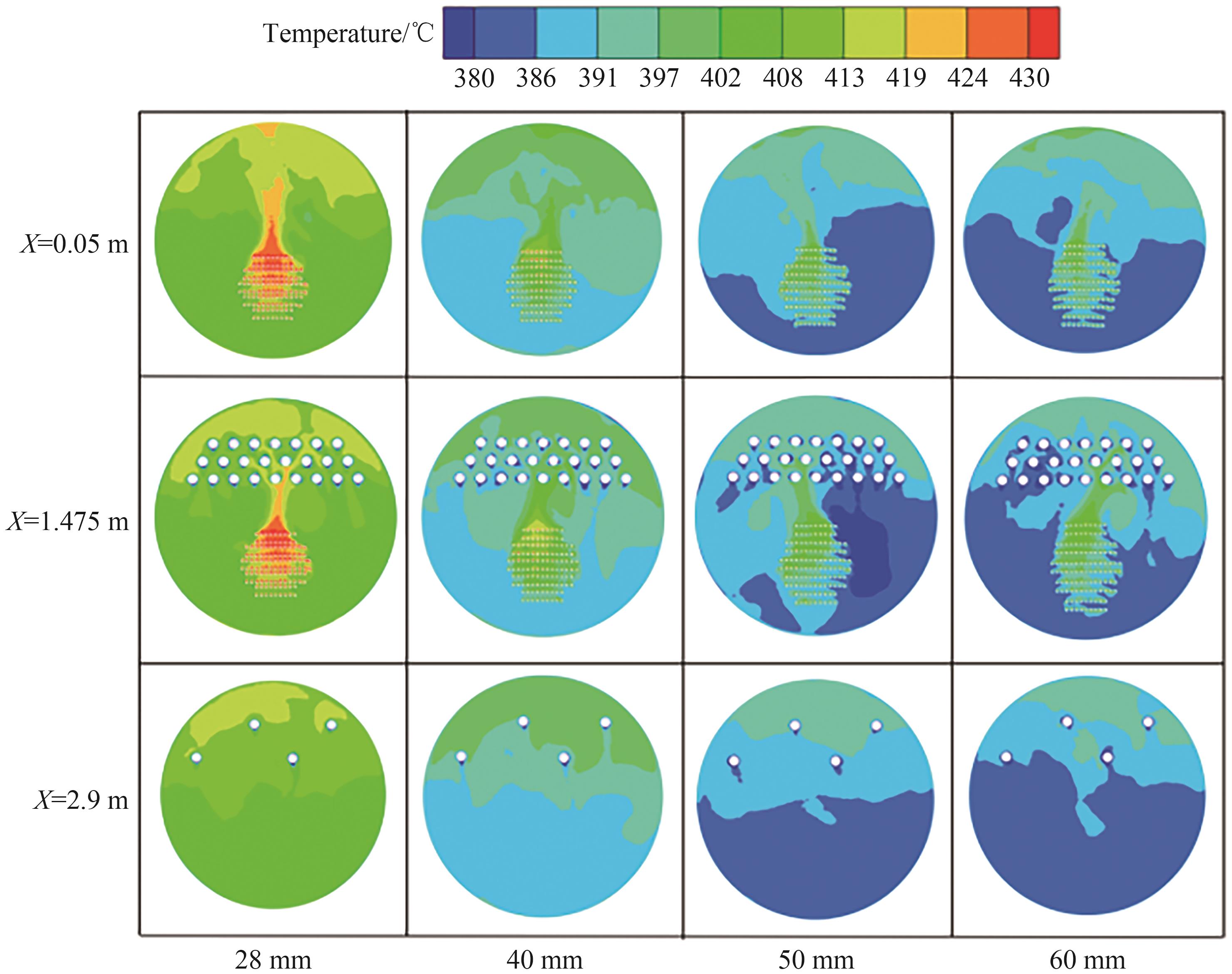
图13 长方形排布下不同管间距a时的截面温度分布
Fig.13 Section temperature distributions of different tube spacings a in rectangular arrangement
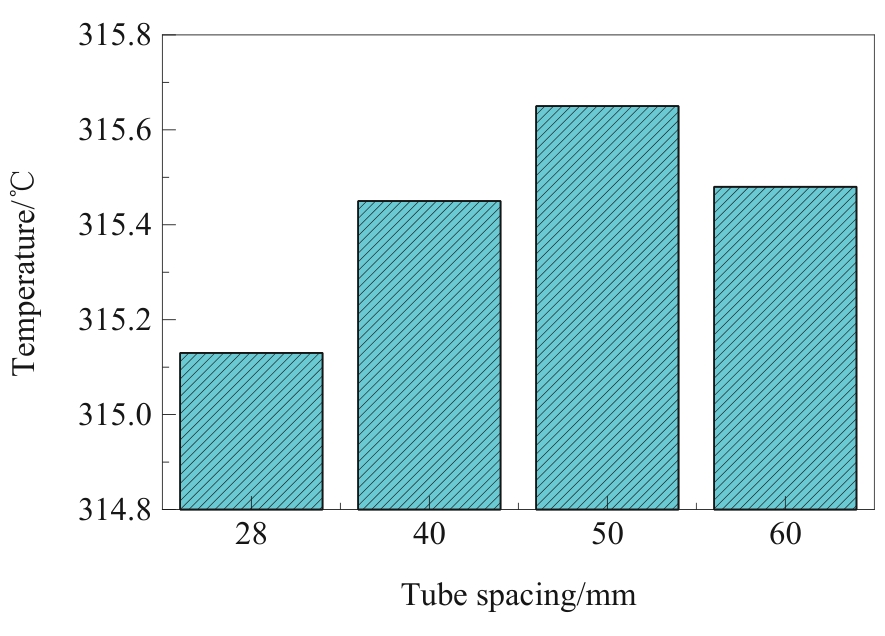
图14 长方形排布下不同管间距a时的导热油出口温度
Fig.14 Outlet temperature of thermal oil with different tube spacings a in rectangular arrangement
| [1] | Cheng C C, Tsai S M, Cheng H P, et al. Analysis for heat transfer enhancement of helical and electrical heating tube heat exchangers in vacuum freeze-drying plant [J]. International Communications in Heat and Mass Transfer, 2014, 58: 111-117. |
| [2] | 郑炜博, 孙东, 李云飞, 等. 新型相变蓄热式电加热装置蓄热性能优化研究 [J]. 重庆理工大学学报(自然科学), 2023, 37(9): 356-364. |
| Zheng W B, Sun D, Li Y F, et al. Research on optimization of heat storage performance of a new phase change heat storage electric heating device [J]. Journal of Chongqing University of Technology (Natural Science), 2023, 37(9): 356-364. | |
| [3] | Behera M, Nayak J, Bal S. Heat transfer analysis of CuO-ZnO/water hybrid nanofluid in a shell and tube heat exchanger with various tube shapes [J]. International Journal of Thermofluids, 2024, 24: 100972. |
| [4] | Ghorbani N, Taherian H, Gorji M, et al. Experimental study of mixed convection heat transfer in vertical helically coiled tube heat exchangers [J]. Experimental Thermal and Fluid Science, 2010, 34: 900-905. |
| [5] | Acharya N, Sen M, Chang H C. Analysis of heat transfer enhancement in coiled-tube heat exchangers [J]. International Journal of Heat and Mass Transfer, 2001, 44: 3189-3199. |
| [6] | Jamshidi N, Farhadi M, Ganji D D, et al. Experimental analysis of heat transfer enhancement in shell and helical tube heat exchangers [J]. Applied Thermal Engineering, 2013, 51: 644-652. |
| [7] | Yuan Y Y, Cao J M, Zhang Z, et al. Numerical simulation and multi-objective optimization design of conjugate heat transfer in novel double shell-passes multi-layer helically coiled tubes heat exchangers [J]. Case Studies in Thermal Engineering, 2024, 62: 105155. |
| [8] | 郭春生, 程林, 杜文静. 不同波纹比例新型板式换热器的传热、阻力特性及㶲分析 [J]. 中国石油大学学报(自然科学版), 2012, 36(2): 163-167. |
| Guo C S, Cheng L, Du W J. Heat transfer, pressure drop characteristics and exergy analysis of new plate heat exchangers with different wave ratios [J]. Journal of China University of Petroleum (Edition of Natural Science), 2012, 36(2): 163-167. | |
| [9] | 黄乃健. 管壳式换热器的壳侧结构改进与传热性能提升 [J]. 中国机械, 2023, (21): 38-41. |
| Huang N J. Improvement of shell side structure and enhancement of heat transfer performance of shell and tube heat exchanger [J]. China Mechanical Engineering, 2023, (21): 38-41. | |
| [10] | 付文涛, 卢军, 李永财, 等. 管道相对表面积对壳管式换热器流动与传热的影响 [J]. 暖通空调, 2018, 48(10): 93-97. |
| Fu W T, Lu J, Li Y C, et al. Influence of relative surface area of tubes on flow and heat transfer in shell and tube heat exchangers [J]. Heating, Ventilating and Air Conditioning, 2018, 48(10): 93-97. | |
| [11] | Duan Y R, Zhang X Y, Han Z Y, et al. Numerical simulation of flow and heat transfer performance of tube-shell coupled helically coiled corrugated tube heat exchanger [J]. International Communications in Heat and Mass Transfer, 2024, 153: 107325. |
| [12] | Wang D B, Zang R Z, Wang G H, et al. Numerical study of heat transfer performance and flow characteristic of water in a multi-wound pipe heat exchanger [J]. Thermal Science and Engineering Progress, 2024, 52: 102683. |
| [13] | 曹学文, 石倩, 边江, 等. 基于联合仿真的板翅式换热器换热特性模拟 [J]. 中国石油大学学报(自然科学版), 2020, 44(3): 148-154. |
| Cao X W, Shi Q, Bian J, et al. Simulation of heat transfer characteristics of plate-fin heat exchangers based on co-simulation [J]. Journal of China University of Petroleum (Edition of Natural Science), 2020, 44(3): 148-154. | |
| [14] | Jasim D J, Mahdi M S, Mahdy O S, et al. Hydrothermal analysis of hybrid nanofluid flow inside a shell and double coil heat exchanger: numerical examination [J]. International Journal of Thermofluids, 2024, 23: 100770. |
| [15] | Wang Y H, Hou T, Cui C J, et al. Theoretical modeling of process heat transfer mechanism in U-shaped molten salt heat exchanger [J]. Energy, 2024, 308: 132795. |
| [16] | Gao H B, Zhang Y Q, Liu Y Q, et al. Numerical simulation of heat transfer performance of different heat exchange tubes in heat recovery steam generator [J]. Process Safety and Environmental Protection, 2022, 163: 506-512. |
| [17] | 姜芳芳. 水在螺旋盘管内的换热及流动特性研究 [D]. 西安: 西安科技大学, 2013: 28. |
| Jiang F F. Research on heat transfer and flow characteristics of water in a spiral coil [D]. Xi'an: Xi'an University of Science and Technology, 2013: 28. | |
| [18] | 胡豹. 折流板结构对管壳式换热器性能影响研究 [D]. 武汉: 江汉大学, 2023: 70. |
| Hu B. Research on the Influence of baffle structure on the performance of shell and tube heat exchangers [D]. Wuhan: Jianghan University, 2023: 70. | |
| [19] | 王强, 石玉环, 石玉萍. 基于Fluent的螺旋盘管相变换热器蓄放热过程仿真研究 [J]. 黑龙江工程学院学报(自然科学版), 2012, 26(3): 17-21. |
| Wang Q, Shi Y H, Shi Y P. Simulation of heat storage and release processes in a spiral coil phase-change heat exchanger based on Fluent [J]. Journal of Heilongjiang Institute of Technology (Natural Science Edition), 2012, 26(3): 17-21. | |
| [20] | Barraza-Colón J, Picón-Núñez M. Improved heat recovery using twisted tube exchanger technology [J]. Cleaner Engineering and Technology, 2022, 10: 100557. |
| [21] | Fetuga I A, Olakoyejo O T, Abolarin S M, et al. Numerical analysis of thermal performance of waste heat recovery shell and tube heat exchangers on counter-flow with different tube configurations [J]. Alexandria Engineering Journal, 2023, 64: 859-875. |
| [22] | 江华, 毛羽, 吴德飞, 等. 连续重整加热炉内多火焰组合燃烧的数值模拟 [J]. 中国石油大学学报(自然科学版), 2004, (3): 78-83, 142. |
| Jiang H, Mao Y, Wu D F, et al. Numerical simulation of multi-flame combined combustion in continuous reformer furnace [J]. Journal of China University of Petroleum (Edition of Natural Science), 2004, (3): 78-83, 142. | |
| [23] | 路阳, 彭国伟, 王智平, 等. 熔融盐相变储热材料的研究现状及发展趋势 [J]. 材料导报, 2011, 25(21): 38-42. |
| Lu Y, Peng G W, Wang Z P, et al. Research status and development trend of molten salt phase change heat storage materials [J]. Materials Review, 2011, 25(21): 38-42. | |
| [24] | 王政. 天然气水套加热炉数值模拟研究 [D]. 青岛: 中国石油大学(华东), 2017: 32. |
| Wang Z. Numerical simulation of natural gas jacket heater [D]. Qingdao: China University of Petroleum (East China), 2017: 32. |
| [1] | 朱建军 李敖东 姬煜晨 彭建霖 张永学 朱海文. 同心双管水力射流泵气液两相流特征参数优化[J]. 过程工程学报, 2026, 26(3): 233-244. |
| [2] | 鲁进利 吴雅勤 韩亚芳 王昌龙 孙彦红 陈星雨. 基于OpenFOAM-DEM的相变微胶囊悬浮液层流传热特性研究[J]. 过程工程学报, 2026, 26(1): 11-19. |
| [3] | 贾春桦 王玮 丁续 王冠达 魏丽燕 王娟. 管壳式电加热炉结构设计对温度分布的影响研究[J]. 过程工程学报, 2025, 25(9): 895-904. |
| [4] | 柳玉杰 张兴淦 彭前 范鼎东 邓爱军 夏云进. 转炉炼钢供氧量预测的混合建模与多网络优化[J]. 过程工程学报, 2025, 25(5): 500-509. |
| [5] | 任永苍 柳楠 孙凤枝 贾春桦 郭新勇 黄春建 赵卫东 王冠达 张瑞 王娟. 间接式熔盐电加热炉流动及传热特性研究[J]. 过程工程学报, 2025, 25(12): 1227-1237. |
| [6] | 巩向阳 杨雷 首时 赵翔宇 龚剑洪 杨超. 变径快速流化床内气固流动特性的双流体模拟研究[J]. 过程工程学报, 2025, 25(11): 1130-1142. |
| [7] | 袁炳 郭进军 李晓飞 梁军辉 李振祥 龙晓东 姜从斌. 气化炉激冷室中多相流动过程模拟与结构优化[J]. 过程工程学报, 2024, 24(3): 315-325. |
| [8] | 王梓龙 刘桂莲. 基于BP神经网络与遗传算法的液烃回收装置参数预测与优化[J]. 过程工程学报, 2024, 24(11): 1284-1296. |
| [9] | 袁慎峰 金玲贞 陈志荣 尹红. 基于CFD的搅拌萃取塔结构优化与流场分析[J]. 过程工程学报, 2023, 23(5): 681-690. |
| [10] | 廖文玲. 基于偏态和峰度的丁胞传热管性能分析[J]. 过程工程学报, 2021, 21(5): 530-540. |
| [11] | 王志奇 邹玉洁 刘柏希 张振康. 热风循环隧道烘箱的流场模拟及结构优化[J]. 过程工程学报, 2020, 20(5): 531-539. |
| [12] | 方璨 钱付平 叶蒙蒙 韩云龙 鲁进利. 无纺针刺毡滤料褶式滤袋的阻力特性分析[J]. 过程工程学报, 2020, 20(3): 285-293. |
| [13] | 张雪宽 徐骥 孙俊杰 张永杰 张正好. 竖冷设备结构的离散元法模拟优化[J]. 过程工程学报, 2020, 20(2): 158-166. |
| [14] | 鲁进利 吕勇军 韩亚芳 钱付平. 细小槽道换热器内相变微胶囊悬浮液对流传热DPM模拟[J]. 过程工程学报, 2018, 18(5): 951-956. |
| [15] | 尧兢 朱鹏飞 任佳伟 吴震. 耦合相变储热的金属氢化物反应器吸氢过程模拟[J]. 过程工程学报, 2018, 18(5): 1093-1101. |
| 阅读次数 | ||||||
|
全文 |
|
|||||
|
摘要 |
|
|||||

