碳酸铵高效浸出黄铜矿的机理研究
收稿日期: 2025-12-09
修回日期: 2026-02-09
网络出版日期: 2026-09-28
基金资助
中国科学院战略性先导科技专项(XDA0430304)
Mechanism study on efficient leaching of chalcopyrite by ammonium carbonate
Received date: 2025-12-09
Revised date: 2026-02-09
Online published: 2026-09-28
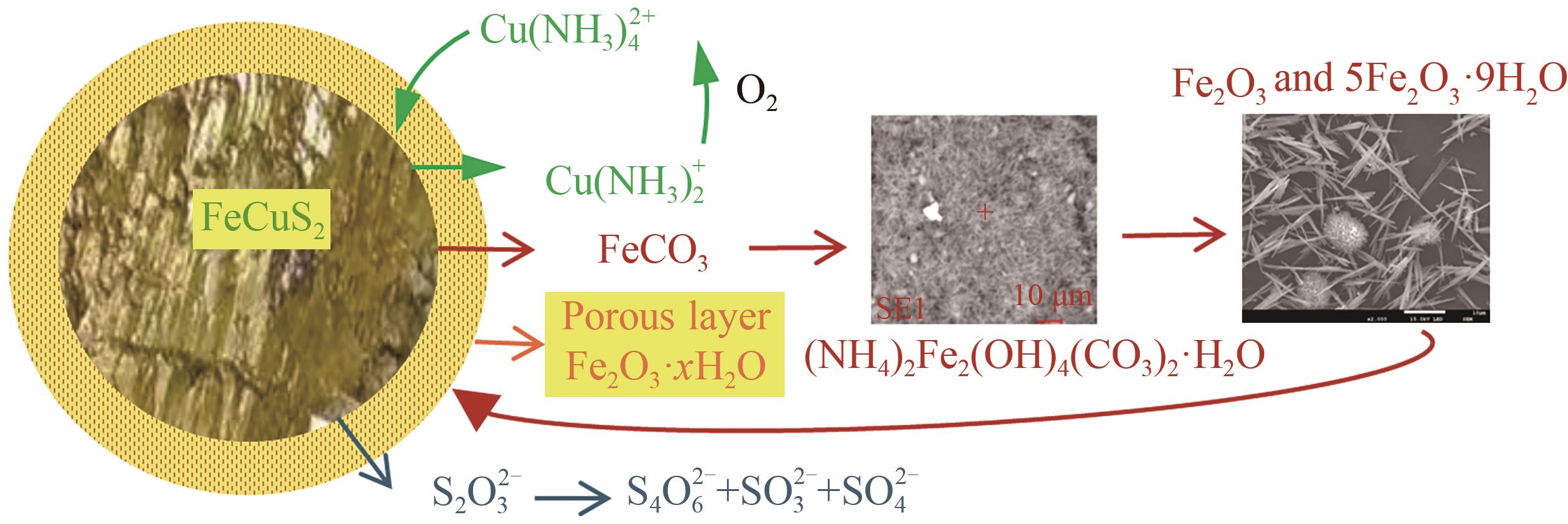
黄铜矿氨浸过程中产生的铁氧化物等中间产物是导致矿物表面钝化和制约浸出效率的关键因素,一直是该领域的研究热点。为阐明(NH4)2CO3体系浸出黄铜矿的速率显著高于其他铵盐体系的原因,本工作利用密闭的磁力搅拌装置,系统探究低氧条件下(NH4)2CO3浸出黄铜矿的动力学行为及反应机理。结果表明,(NH4)2CO3可高效浸出黄铜矿,密闭低氧条件下铜浸出率达89.67%。通过采用扫描电子显微镜-能量色散X射线谱仪(SEM-EDS)、X射线衍射(XRD)、拉曼光谱及热重-差示扫描量热法及TG-DSC等多种表征技术,发现(NH4)2CO3浸出黄铜矿过程的中间产物为(NH4)2Fe2(OH)4(CO3)2·H2O,该中间产物大多分散于浸出液中,部分以疏松多孔的形态沉积在黄铜矿表面,对黄铜矿浸出动力学影响较小。热力学计算与溶液化学实验证实,黄铜矿表面氧化溶解的Fe2+可与溶液中的
孙和云 , 阮仁满 , 邓久帅 , 牛晓鹏 . 碳酸铵高效浸出黄铜矿的机理研究[J]. 过程工程学报, 2026 , 26(9) : 1021 -1030 . DOI: 10.12034/j.issn.1009-606X.225308
Intermediate iron oxides and other products formed during the ammonia leaching of chalcopyrite are considered primary causes of passivation and restricting leaching efficiency, making them a persistent research focus in this field. To elucidate why the leaching rate of chalcopyrite in the (NH4)2CO3 system is significantly higher than in other ammonium salt systems, this work systematically investigates the kinetic behavior and reaction mechanism of chalcopyrite leaching by (NH4)2CO3 under low-oxygen conditions using a sealed magnetic stirring apparatus. The results demonstrate that (NH4)2CO3 can efficiently leach chalcopyrite, the copper extraction efficiency reaches 89.67%. Through various characterization techniques including scanning electron microscopy-energy dispersive X-ray spectroscopy (SEM-EDS), X-ray diffraction (XRD), Raman spectroscopy, and thermogravimetry-differential scanning calorimetry (TG-DSC), the intermediate product formed during the (NH4)2CO3 leaching process is identified as (NH4)2Fe2(OH)4(CO3)2·H2O. This intermediate product partially disperses in the leaching solution and partially deposits on the chalcopyrite surface in a loose, porous morphology, exerting minimal influence on leaching kinetics. Thermodynamic calculations and solution chemistry experiments confirmed that Fe2+ oxidized and dissolved from the chalcopyrite surface can form stable soluble complexes with
| [1] | Yang Q R, Jia Y, Zhang L H, et al. Contribution of sessile acidophiles on chalcopyrite bioleaching under controlled redox potentials [J]. Minerals, 2025, 15(5): 480. |
| [2] | Xu J, Wang H L, Gao C Q, et al. Effect of different crushing methods on chalcopyrite liberation and heavy media preconcentration [J]. Minerals, 2025, 15(2): 179. |
| [3] | Tang Y, Sun D Y, Gou J, et al. Chalcopyrite geochemistry: advancements and implications in ore deposit research [J]. Ore Geology Reviews, 2025, 179: 106528. |
| [4] | Komorita K, Taninouchi Y, Nakano H. Effects of thermal pretreatment on the oxidative dissolution of chalcopyrite: electrochemical study with synthetic minerals [J]. Materials Transactions, 2025, 66(3): 318-327. |
| [5] | Ortega F, Petersen J, Velasquez-Yevenes L. A preliminary study of electro-reduction pretreatment preceding chalcopyrite leaching in ammonium chloride media in the presence of copper ions [J]. Hydrometallurgy, 2025, 236: 106508. |
| [6] | Barton I F, Hiskey J B. Chalcopyrite leaching in novel lixiviants [J]. Hydrometallurgy, 2022, 207: 105775. |
| [7] | 彭宇, 肖发新, 孙树臣, 等. 高碱性脉石低品位氧化铜矿提铜研究进展 [J]. 有色金属科学与工程, 2020, 11(5): 69-74. |
| Peng Y, Xiao F X, Sun S C, et al. Research progress on copper extraction from low-grade copper oxide ores with high alkaline gangue [J]. Nonferrous Metals Science and Engineering, 2020, 11(5): 69-74. | |
| [8] | 涂桃枝, 韩宝玲, 黄成春, 等. 氨浸-氰化法处理含铜金精矿的研究 [J]. 化工冶金, 1989, (4): 38-43. |
| Tu T Z, Han B L, Huang C C, et al. Study on ammonia leaching-cyanidation process for treating copper-bearing gold concentrate [J]. Engineering Chemistry & Metallurgy, 1989, (4): 38-43. | |
| [9] | 烟伟. 混合铜矿的高压氨浸工艺 [J]. 化工冶金, 2000, (4): 403-406. |
| Yan W. High-pressure ammonia leaching process for mixed copper ores [J]. Engineering Chemistry & Metallurgy, 2000, (4): 403-406. | |
| [10] | Zheng X, Ma B Z, Zhang W W, et al. A novel process for selective ammonia leaching and preparing ternary lithium battery from mixed hydroxide precipitation [J]. Process Safety and Environmental Protection, 2025, 197: 107039. |
| [11] | Saim A K. Ammoniacal leaching for the extraction of valuable metals from secondary resources: a review [J]. Mineral Processing and Extractive Metallurgy Review, 2025, 46(2): 284-305. |
| [12] | Moyo T. Study of the dissolution of chalcopyrite in solutions of different ammonium salts [J]. Journal of the Southern African Institute of Mining and Metallurgy, 2016, 116(6): 509-516. |
| [13] | Beckstead L W, Miller J D. Ammonia, oxidation leaching of chalcopyrite-surface deposit effects [J]. Metallurgical Transactions B, 1977, 8: 31-38. |
| [14] | Warren G W, Wadsworth M E. The electrochemical oxidation of chalcopyrite in ammoniacal solutions [J]. Metallurgical Transactions B, 1984, 15(2): 289-297. |
| [15] | Hua X M, Zheng Y F, Xu Q, et al. Interfacial reactions of chalcopyrite in ammonia-ammonium chloride solution [J]. Transactions of Nonferrous Metals Society of China, 2018, 28(3): 556-566. |
| [16] | Moyo T, Petersen J, Nicol M J. The electrochemistry and kinetics of the oxidative dissolution of chalcopyrite in ammoniacal solutions: part I-anodic reactions [J]. Hydrometallurgy, 2018, 182: 97-103. |
| [17] | Moyo T, Petersen J, Nicol M J. The electrochemistry and kinetics of the oxidative dissolution of chalcopyrite in ammoniacal solutions. part II-cathodic reactions [J]. Hydrometallurgy, 2019, 184: 67-74. |
| [18] | Beckstead L W, Miller J D. Ammonia, oxidation leaching of chalcopyrite-reaction kinetics [J]. Metallurgical Transactions B, 1977, 8(1): 19-29. |
| [19] | Nabizadeh A, Aghazadeh V. Dissolution study of chalcopyrite concentrate in oxidative ammonia/ammonium carbonate solutions at moderate temperature and ambient pressure [J]. Hydrometallurgy, 2015, 152: 61-68. |
| [20] | Sun H Y, Ruan R M, Deng J S. Kinetics of chalcopyrite dissolution in ammonia solution under sealed conditions and controlled redox potential [J]. Transactions of Nonferrous Metals Society of China, 2025, 35(5): 1691-1703. |
| [21] | 张琪. 乙烯硫脲和铵盐强化黄铜矿浸出的研究 [D]. 北京: 中国科学院大学, 2022. |
| Zhang Q. Study on enhancing chalcopyrite leaching with ethylene thiourea and ammonium salts [D]. Beijing: University of Chinese Academy of Sciences, 2022. | |
| [22] | 牛晓鹏. 方铅矿、黄铜矿和黄铁矿表面氧化与可浮性研究 [D]. 北京: 中国科学院大学, 2019. |
| Niu X P. Study on surface oxidation and floatability of galena, chalcopyrite and pyrite [D]. Beijing: University of Chinese Academy of Sciences, 2019. | |
| [23] | Dvorak V, Feitknechtw W. Basic iron(3) carbonates 2. preparation radiocrystallography and infrared spectra of (NH4)2Fe2(OH)4(CO3)2·H2O [J]. Helvetica Chimica Acta, 1969, 52(2): 515. |
| [24] | Pacheco T S, Ludwig Z M, Oliveira V H, et al. Synthesis, thermal analysis, spectroscopic properties, and degradation process of tutton salts doped with AgNO3 or H3BO3 [J]. ACS Omega, 2023, 8(20): 17800-17808. |
| [25] | Pacheco T S, Ludwig Z M, Ullah S, et al. Magnetic characterization, electronic structure and vibrational properties of (NH4)2M(SO4)2·6H2O (M=Mn, Ni) crystals [J]. Solid State Communications, 2021, 334: 114384. |
| [26] | Hanesch M. Raman spectroscopy of iron oxides and (oxy)hydroxides at low laser power and possible applications in environmental magnetic studies [J]. Geophysical Journal International, 2009, 177(3): 941-948. |
| [27] | Das S, Hendry M J. Application of Raman spectroscopy to identify iron minerals commonly found in mine wastes [J]. Chemical Geology, 2011, 290(3/4): 101-108. |
| [28] | Herman R, Bogdan C, Sommer A, et al. Discrimination among carbonate minerals by Raman spectroscopy using the laser microprobe [J]. Applied Spectroscopy, 1987, 41: 437-440. |
| [29] | Perkins R S, Garber J D. Raman spectroscopy of iron in aqueous carbonate solutions [J]. Journal of Solution Chemistry, 2003, 32(3): 265-272. |
| [30] | De Faria D L A, Lopes F N. Heated goethite and natural hematite: can Raman spectroscopy be used to differentiate them? [J]. Vibrational Spectroscopy, 2007, 45(2): 117-121. |
| [31] | Ma Y L, Yang Y, Fan R, et al. Chalcopyrite leaching in ammonium chloride solutions under ambient conditions: insight into the dissolution mechanism by XANES, Raman spectroscopy and electrochemical studies [J]. Minerals Engineering, 2021, 170: 107063. |
| [32] | Marshall C P, Stockdale G, Carr C A. Raman spectroscopy of geological varieties of hematite of varying crystallinity and morphology [J]. Journal of Raman Spectroscopy, 2025, 56(7): 590-597. |
| [33] | Bejaoui A, Souamti A, Kahlaoui M, et al. Synthesis, characterization, thermal analysis and electrical properties of (NH4)2M(SO4)2·6H2O (M=Cu, Co, Ni) [J]. Materials Science and Engineering: B, 2019, 240: 97-105. |
| [34] | Ciomartan D A, Clark R J H, McDonald L J, et al. Studies on the thermal decomposition of basic lead(II) carbonate by Fourier-transform Raman spectroscopy, X-ray diffraction and thermal analysis [J]. Journal of the Chemical Society, 1996, (18): 3639-3645. |
| [35] | Caldeira C L, Ciminelli V S T, Osseo-Asare K. The role of carbonate ions in pyrite oxidation in aqueous systems [J]. Geochimica et Cosmochimica Acta, 2010, 74(6): 1777-1789. |
| [36] | Osseo-Asare I. Application of activity-activity diagrams to ammonia hydrometallurgy-4-Fe-NH3-H2O, Fe-NH3-H2O-CO3 and Fe-NH3-H2O-SO4 systems at 25℃ [J]. Transactions of the Institution of Mining and Metallurgy, Section C: Mineral Processing and Extractive Metallurgy, 1981, 90: 159-163. |
| [37] | Klocke D J, Hixson A N. Solubility of ferrous iron in aqueous ammoniacal solutions [J]. Industrial and Engineering Chemistry Process Design and Development, 1972, 11(1): 141-146. |
/
| 〈 |
|
〉 |