废弃钻井液破胶过程的交互作用分析与工艺参数优化
收稿日期: 2025-12-16
修回日期: 2026-03-02
网络出版日期: 2026-09-28
基金资助
陕西省教育厅服务专项计划(24JC071)
Interaction effects analysis and process parameter optimization for gel breaking of waste drilling fluid
Received date: 2025-12-16
Revised date: 2026-03-02
Online published: 2026-09-28
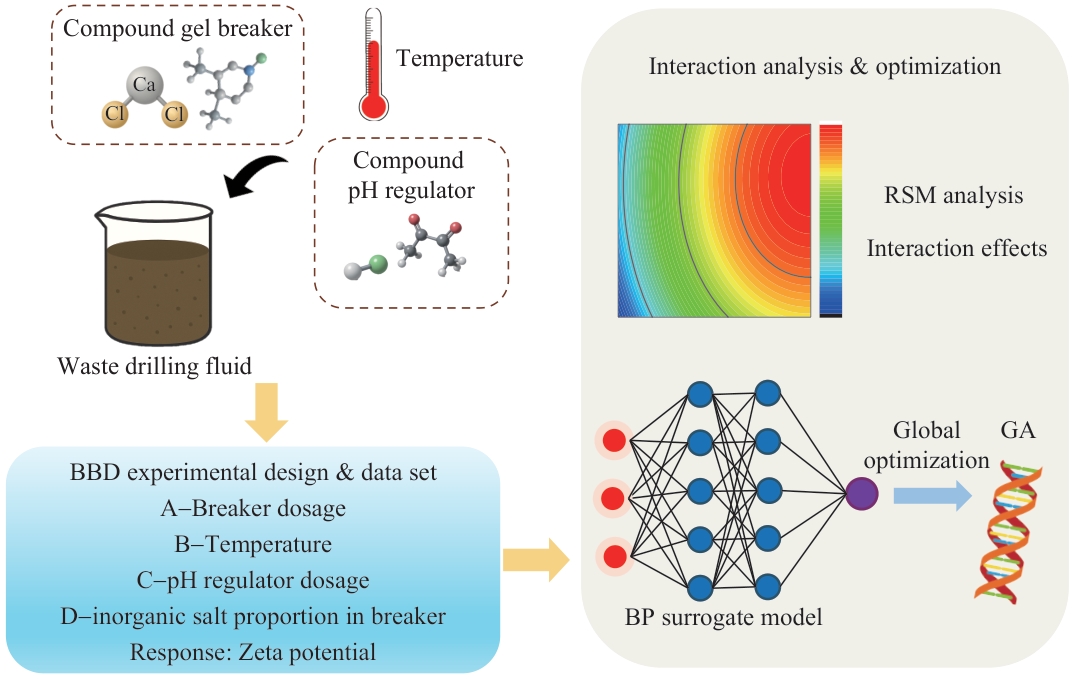
为实现钻井废液的高效回用,以Zeta电位表征体系稳定性,研究废弃钻井液破胶过程中关键工艺因素对稳定性的影响。首先采用单因素实验系统考察破胶剂用量、反应温度、pH调节剂加注量以及破胶剂中无机盐占比对Zeta电位的影响规律。随后基于Box-Behnken设计构建响应面实验体系,并利用响应面法对关键因素交互作用进行分析,为参数优化提供可解释依据。依据实验数据分别建立BP神经网络、随机森林(RF)回归与高斯过程回归(GPR)三种代理模型,并结合5折交叉验证对模型预测性能与泛化能力进行对比评价。研究表明,BP模型综合表现最优,其整体决定系数R2为0.9629,且5折交叉验证平均决定系数R2为0.8125,显著优于其他代理模型,能较为精准地预测Zeta电位。基于BP神经网络并结合遗传算法(GA)进行全局寻优,得到的最佳工艺为:破胶剂用量3.306 g/L、反应温度57.74℃、pH调节剂加注量3.45 g/L、无机盐占比0.80,对应预测Zeta电位为-10.735 mV。该研究结果为废弃钻井液脱稳以及后续回用提供了理论依据和数据支持。
李艺涵 , 李志潇 , 革晓东 , 胡科先 , 万征平 , 范峥 . 废弃钻井液破胶过程的交互作用分析与工艺参数优化[J]. 过程工程学报, 2026 , 26(9) : 1007 -1020 . DOI: 10.12034/j.issn.1009-606X.225312
Waste drilling fluids are difficult to reuse because they are strongly alkaline and remain highly stable as dispersed colloidal systems, which hinders solid-liquid separation. Therefore, gel breaking and destabilization are required before reuse. The destabilization efficiency is controlled by multiple operating conditions, among which breaker dosage, reaction temperature, pH regulator dosage, and inorganic salt proportion are critical. In this study, the Zeta potential of the treated drilling fluid was used as the stability indicator because it sensitively reflected changes in particle aggregation and dispersion. Based on experimental data obtained from a Box-Behnken design (BBD), response surface methodology (RSM) combined with analysis of variance (ANOVA) was employed to assess the significance of main effects and interactions among factors. Building on these results, three surrogate models—a backpropagation neural network (BP-ANN), random forest regression (RF), and Gaussian process regression (GPR)—were constructed to predict and compare the performance of Zeta potential modeling. Results indicated that the BP neural network achieved optimal fitting performance, with an overall coefficient of determination (R2) of 0.9629 and an average R2 of 0.8125 under 5-fold cross-validation—significantly higher than those of other surrogate models. Thus, it was selected as the process optimization model. To further identify the optimal solution, a genetic algorithm (GA) was integrated with BP-ANN for global optimization. The GA-BP method yielded optimal parameters: gel breaker dosage of 3.306 g/L, reaction temperature of 57.74℃, pH adjuster dosage of 3.45 g/L, an inorganic salt proportion of 0.80, and a predicted Zeta potential of -10.735 mV. The measured value was -10.85 mV, with a relative error of 1.06%. Overall, the proposed experimental design-based modeling and optimization framework provides a reliable basis for determining operating parameters for gel breaking and destabilization, and supports the subsequent reuse of treated drilling fluids.
| [1] | 田野. 废弃钻井液处理技术探讨 [J]. 西部探矿工程, 2021, 33(3): 30-31. |
| Tian Y. Discussion on treatment technology of waste drilling fluid [J]. West-China Exploration Engineering, 2021, 33(3): 30-31. | |
| [2] | 何长明, 李俊华, 王佳. 废弃钻井液无害化处理技术的研究 [J]. 应用化工, 2016, 45(9): 1792-1794. |
| He C M, Li J H, Wang J. Study on harmless treatment technology of waste drilling fluid [J]. Applied Chemical Industry, 2016, 45(9): 1792-1794. | |
| [3] | 王建来. 浅谈钻井液性能对钻井井身质量的影响 [J]. 中国石油和化工标准与质量, 2024, 44(17): 16-18. |
| Wang J L. Discussion on the impact of drilling fluid performance on drilling wellbore quality [J]. China Petroleum and Chemical Standard and Quality, 2024, 44(17): 16-18. | |
| [4] | 唐国旺, 赵中军, 杨勇, 等. 生物碳化固化水基钻屑作用机理及力学性能研究 [J]. 施工技术, 2024, 53(11): 50-55. |
| Tang G W, Zhao Z J, Yang Y, et al. Mechanism and mechanical properties of bio-carbonation solidification of water-based drilling cuttings [J]. Construction Technology, 2024, 53(11): 50-55. | |
| [5] | 王璐璐. 油田作业废液处理技术现状分析 [J]. 内蒙古石油化工, 2020, 46(9): 92-93. |
| Wang L L. Analysis on the current status of treatment technologies for oilfield operation waste fluids [J]. Inner Mongolia Petrochemical Industry, 2020, 46(9): 92-93. | |
| [6] | 郭布民, 李小凡, 王杏尊, 等. 高温海水基压裂液研究与开发进展 [J]. 中国石油和化工标准与质量, 2018, 38(24): 114-116, 118. |
| Guo B M, Li X F, Wang X Z, et al. Research and development progress of high-temperature seawater-based fracturing fluids [J]. China Petroleum and Chemical Standard and Quality, 2018, 38(24): 114-116, 118. | |
| [7] | 李林静. 废弃水基钻井液固液分离产水回用技术 [J]. 化工环保, 2024, 44(2): 292-296. |
| Li L J. Reuse technology of produced water from solid-liquid separation of waste water-based drilling fluid [J]. Environmental Protection of Chemical Industry, 2024, 44(2): 292-296. | |
| [8] | 王满学, 何静, 杨志刚, 等. 生物酶SUN-1/过硫酸铵对羟丙基瓜胶压裂液破胶和降解作用 [J]. 西安石油大学学报(自然科学版), 2011, 26(1): 71-75, 120-121. |
| Wang M X, He J, Yang Z G, et al. Gel breaking and degradation of hydroxypropyl guar fracturing fluid by bio-enzyme SUN-1/ammonium persulfate [J]. Journal of Xi'an Shiyou University (Natural Science Edition), 2011, 26(1): 71-75, 120-121. | |
| [9] | 黄丹超, 晏玮, 张闯, 等. 水基钻井液用离子液体聚合物包被剂的合成及性能研究 [J]. 应用化工, 2025, 54(5): 1144-1148, 1155. |
| Huang D C, Yan W, Zhang C, et al. Synthesis and performance study of an ionic liquid polymer coating agent for water-based drilling fluid [J]. Applied Chemical Industry, 2025, 54(5): 1144-1148, 1155. | |
| [10] | 童祯恭, 王舒琪, 章曈曈, 等. PM/BS协同混凝沉淀处理排泥水中有机物研究 [J]. 应用化工, 2025, 54(12): 3009-3014. |
| Tong Z G, Wang S Q, Zhang T T, et al. Study on the synergistic coagulation-sedimentation treatment of organic matter in sludge supernatant using PM/BS [J]. Applied Chemical Industry, 2025, 54(12): 3009-3014. | |
| [11] | 孙露露, 耿晓光, 宋涛, 等. 响应面优化深层废弃水基钻井液无害化处理工艺 [J]. 钻井液与完井液, 2022, 39(3): 327-333. |
| Sun L L, Geng X G, Song T, et al. Process optimization of harmless treatment for deep wastewater-based drilling fluid using response surface methodology [J]. Drilling Fluid & Completion Fluid, 2022, 39(3): 327-333. | |
| [12] | Kumar R, Reji M. Response surface methodology (RSM): an overview to analyze multivariate data [J]. Indian Journal of Microbiology Research, 2023, 9(4): 241-248. |
| [13] | 魏东, 马川, 马建民. XGBoost-人工神经网络热力站二次回水温度预测 [J]. 科学技术与工程, 2025, 25(17): 7226-7237. |
| Wei D, Ma C, Ma J M. Prediction of secondary return water temperature in a heat station using XGBoost and artificial neural network [J]. Science Technology and Engineering, 2025, 25(17): 7226-7237. | |
| [14] | 朱鹏, 冯玮. 基于BP神经网络的15Cr14Co12Mo5Ni2齿轮钢本构模型建立及热加工图研究 [J]. 塑性工程学报, 2025, 32(8): 177-186. |
| Zhu P, Feng W. Establishment of constitutive model and hot processing maps of 15Cr14Co12Mo5Ni2 gear steel based on BP neural network [J]. Journal of Plasticity Engineering, 2025, 32(8): 177-186. | |
| [15] | 王冲, 戴理朝, 陈斌. 基于高斯过程回归的锈蚀RC梁抗剪承载力概率模型 [J]. 浙江大学学报(工学版), 2025, 59(11): 2352-2360. |
| Wang C, Dai L C, Chen B. Probabilistic model for the shear capacity of corroded RC beams based on Gaussian process regression [J]. Journal of Zhejiang University (Engineering Science), 2025, 59(11): 2352-2360. | |
| [16] | 吴爱祥, 常英杰, 阮竹恩, 等. 基于随机森林-非支配遗传算法的全尾砂膏体性能智能预测与优化 [J]. 中国有色金属学报, 2025, 35(12): 4433-4446. |
| Wu A X, Chang Y J, Ruan Z E, et al. Intelligent prediction and optimization of full tailings paste performance based on random forest and non-dominated genetic algorithm [J]. The Chinese Journal of Nonferrous Metals, 2025, 35(12): 4433-4446. | |
| [17] | 杜妹玲, 陈志红, 朱轩池, 等. 响应面和粒子群-人工神经网络模型优化微波辅助提取赤芍总苷工艺[J]. 食品工业科技, 2023, 44(15): 248-257. |
| Du M L, Chen Z H, Zhu X C, et al. Process optimization of microwave-assisted extraction of total glycosides from Paeoniae Radix Rubra using response surface methodology and particle swarm optimization-artificial neural network model [J]. Science and Technology of Food Industry, 2023, 44(15): 248-257. | |
| [18] | 刘路漫. 抗高温高盐水基钻井液降滤失剂的研制及应用 [D]. 成都: 西南石油大学, 2023: 10. |
| Liu L M. Development and application of a high-temperature and high-salinity resistant fluid-loss additive for water-based drilling fluids [D]. Chengdu: Southwest Petroleum University, 2023: 10. | |
| [19] | Harry C, Jackson D M. Zeta potential of crude oil in aqueous solution [J]. Advances in Colloid and Interface Science, 2023, 320: 102962. |
| [20] | Mohammadi-Jam S, Greenwood R W, Waters K E. An overview of the temperature dependence of the Zeta potential of aqueous suspensions [J]. Results in Engineering, 2025, 27: 105698. |
| [21] | Chauhan T, Sz?ri-Dorogházi E, Muránszky G, et al. Application of modified clays in the removal of phosphates and E. coli from aqueous solution [J]. Environmental Nanotechnology, Monitoring & Management, 2024, 22: 100965. |
| [22] | Olukowi O M, Xie Y, Zhou Z, et al. Performance improvement and mechanism of composite PAC/PDMDAAC coagulant via enhanced coagulation coupled with rapid sand filtration in the treatment of micro-polluted surface water [J]. Journal of Environmental Chemical Engineering, 2022, 10(5): 108450. |
| [23] | 宋兴, 张海云. RSM-BBD在矿渣基尾砂胶结充填材料配比优化中的应用 [J]. 矿业研究与开发, 2025, 45(6): 59-67. |
| Song X, Zhang H Y. Application of RSM-BBD in mix proportion optimization of slag-based tailings cemented backfill materials [J]. Mining Research and Development, 2025, 45(6): 59-67. | |
| [24] | Nadzirul Z, Nabila N S, Norsyaqira J M, et al. Harvesting aurantiochytrium sp. SW1 via flocculation using chitosan: effects of flocculation parameters on flocculation efficiency and Zeta potential [J]. Marine Drugs, 2023, 21(4): 251. |
| [25] | Spiechowicz J, Marchenko I G, H?nggi P, et al. Diffusion coefficient of a Brownian particle in equilibrium and nonequilibrium: Einstein model and beyond [J]. Entropy, 2023, 25(1): 42. |
| [26] | Mohapatro R N, Swain R, Routray S, et al. Recovery of filler material from mining waste: techno-economic, and kinetic study [J]. Process Safety and Environmental Protection, 2024, 185: 918-929. |
| [27] | Bin L, G.J. S H, Ran S, et al. Integration of oxalic acid chelation and Fenton process for synergistic relaxation-oxidation of persistent gel-like fouling of ceramic nanofiltration membranes [J]. Journal of Membrane Science, 2021, 636: 119553. |
| [28] | ?korňa A, Selianitis D, Pispas S, et al. Association of thermoresponsive diblock copolymer PDEGMA-b-PDIPAEMA in aqueous solutions: the influence of terminal groups [J]. Polymers, 2024, 16(15): 2102. |
/
| 〈 |
|
〉 |