

过程工程学报 ›› 2026, Vol. 26 ›› Issue (9): 929-947.DOI: 10.12034/j.issn.1009-606X.225277
余正伟1,2( ), 韩佳欣1, 陈良军1,2, 陆伟文1, 章新宇1, 袁溢1, 龙红明1,2()
收稿日期:2025-10-30
修回日期:2026-01-14
出版日期:2026-02-13
发布日期:2026-09-28
通讯作者:
龙红明 yuzhengw@ahut.edu.cn;yaflhm@126.com
作者简介:余正伟,副教授,研究方向为智能冶金,E-mail: yuzhengw@ahut.edu.cn;基金资助:
Zhengwei YU1,2(), Jiaxin HAN1, Liangjun CHEN1,2, Weiwen LU1, Xinyu ZHANG1, Yi YUAN1, Hongming LONG1,2()
Received:2025-10-30
Revised:2026-01-14
Online:2026-02-13
Published:2026-09-28
Contact:
Hongming LONG yuzhengw@ahut.edu.cn;yaflhm@126.com
摘要:
(1)烧结工序智能化升级对推动流程工业绿色低碳转型具有重要意义,精准可靠的感知技术是实现烧结过程智能调控与优化的基础。
(2)综述了烧结过程先进感知技术的研究进展,重点分析原料成分、水分、烧结终点与漏风率等关键参数的检测方法。
(3)未来烧结感知体系应面向复杂工况实现多源融合与智能自校准,提升系统稳定性与鲁棒性,推动烧结过程向智能化、绿色化、高效化发展。
中图分类号:
余正伟, 韩佳欣, 陈良军, 陆伟文, 章新宇, 袁溢, 龙红明. 烧结过程先进感知技术的研究现状与展望[J]. 过程工程学报, 2026, 26(9): 929-947.
Zhengwei YU, Jiaxin HAN, Liangjun CHEN, Weiwen LU, Xinyu ZHANG, Yi YUAN, Hongming LONG. Research status and prospects of advanced sensing technologies in the sintering process[J]. The Chinese Journal of Process Engineering, 2026, 26(9): 929-947.
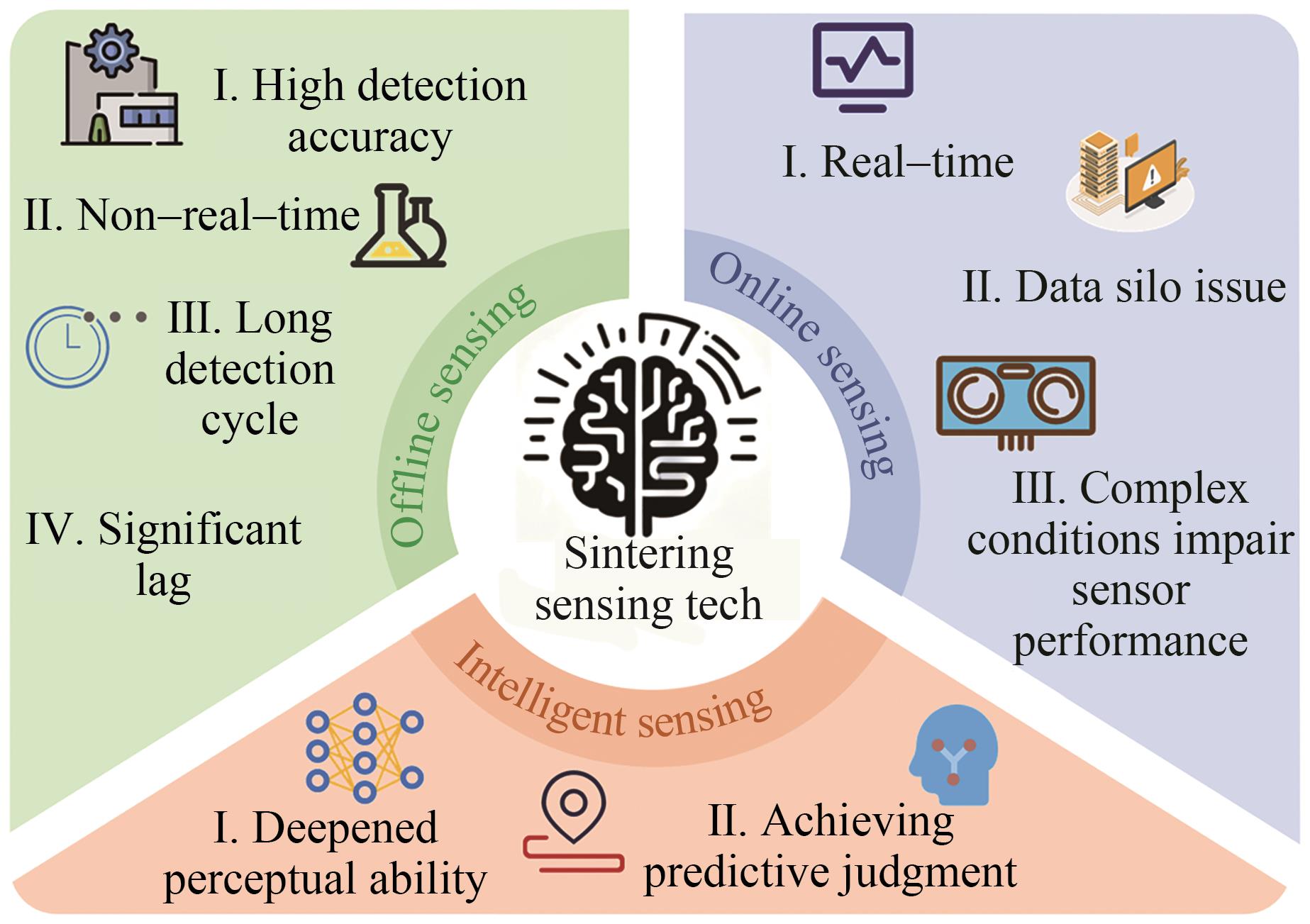
图1 烧结感知技术发展阶段特征图
Fig.1 Schematic diagram of development stage characteristics of sintering sensing technology
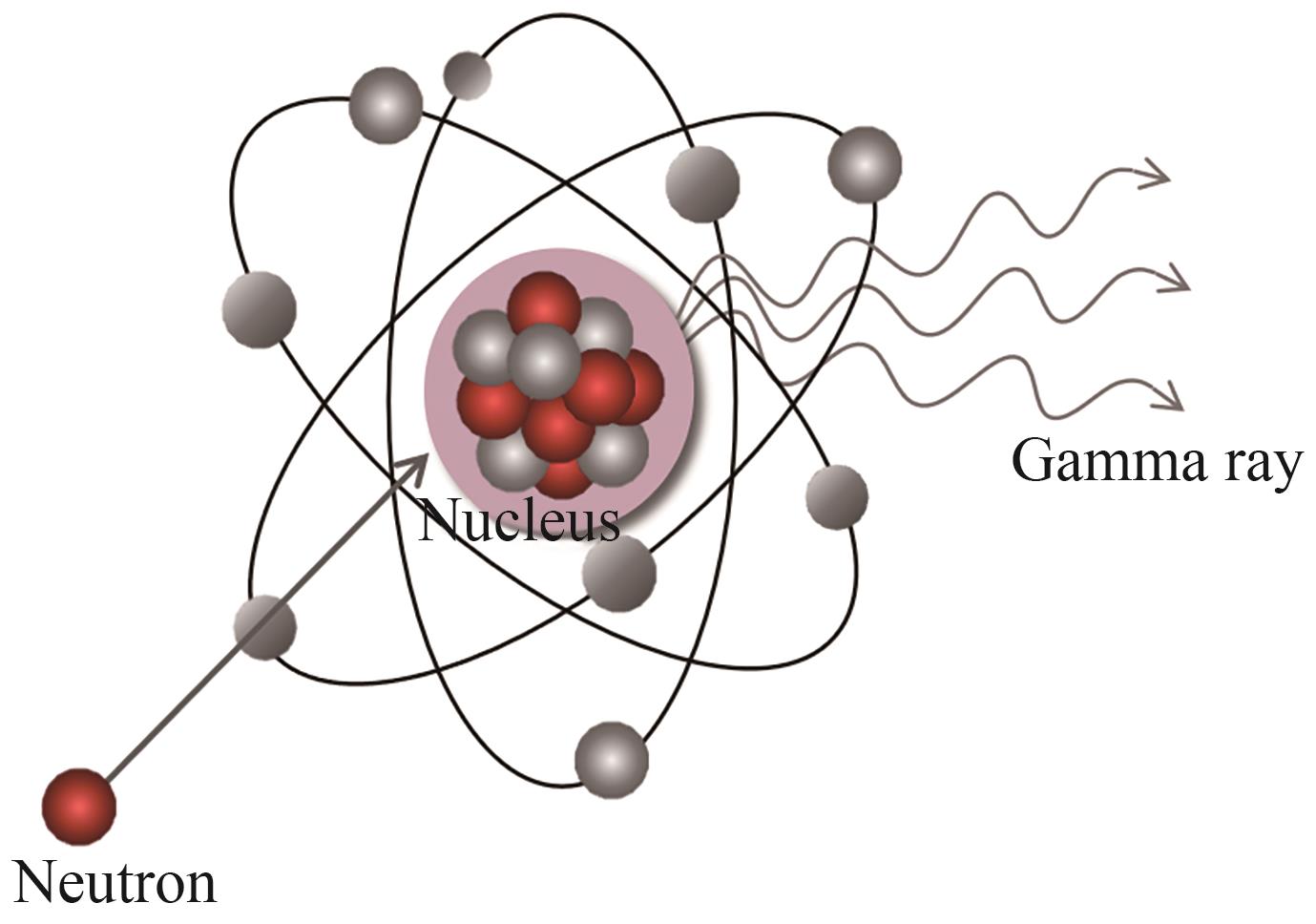
图2 PGNAA原理图
Fig.2 Schematic diagram of PGNAA principle
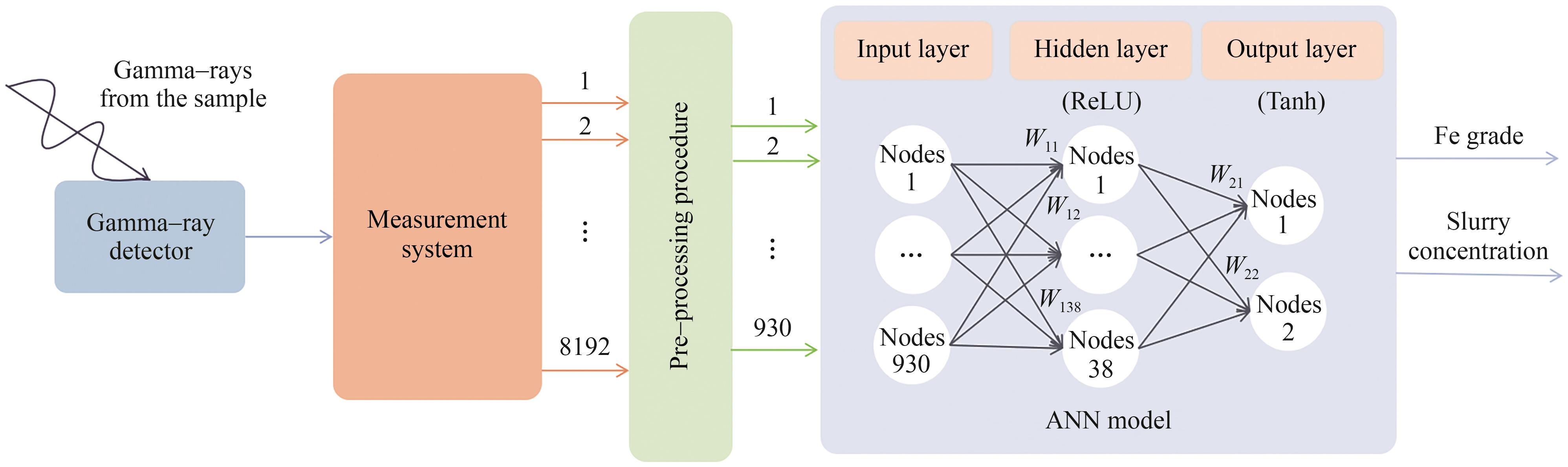
图3 ANN模型与PGNAA分析系统架构示意图[14]
Fig.3 Architecture diagram of ANN model and PGNAA analysis system[14]
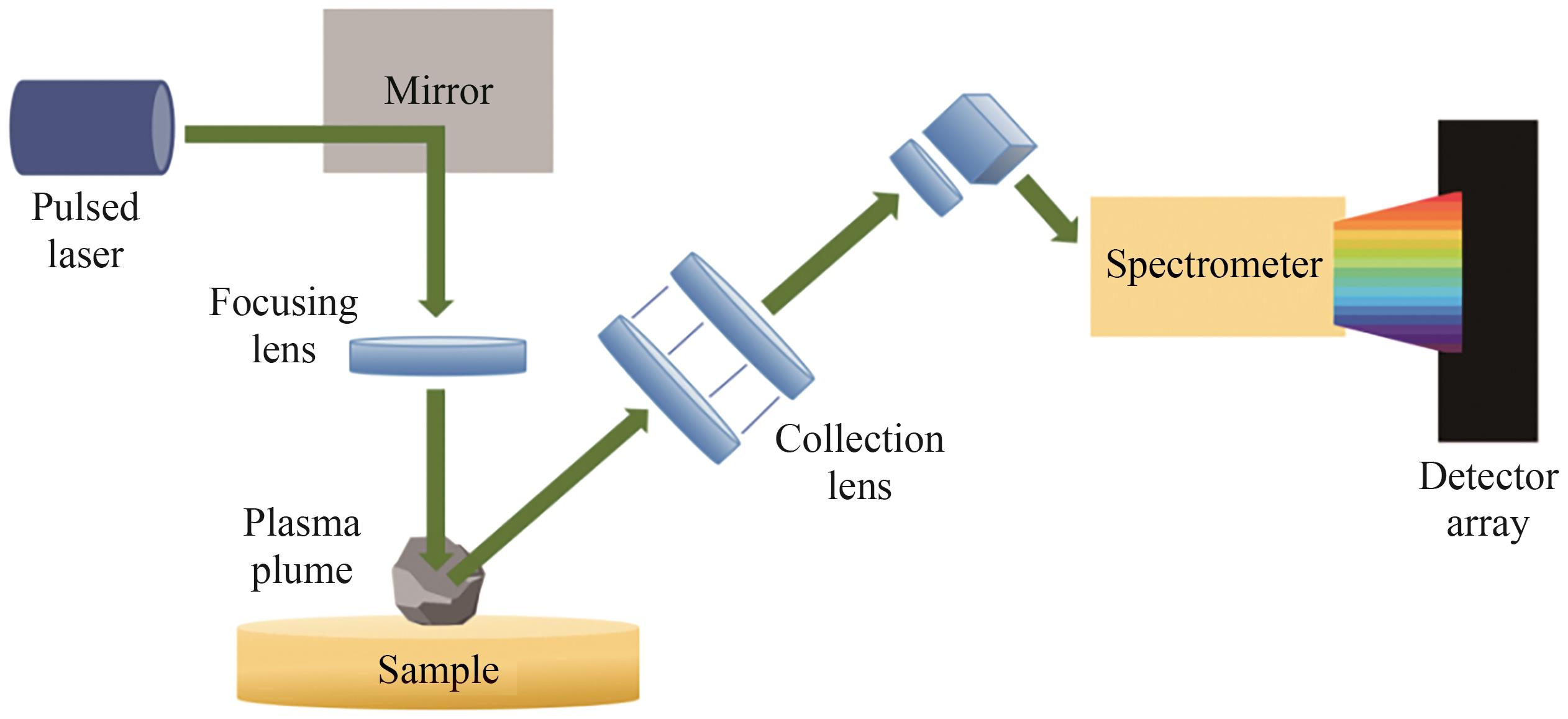
图4 LIBS检测原理图
Fig.4 Schematic diagram of LIBS detection principle
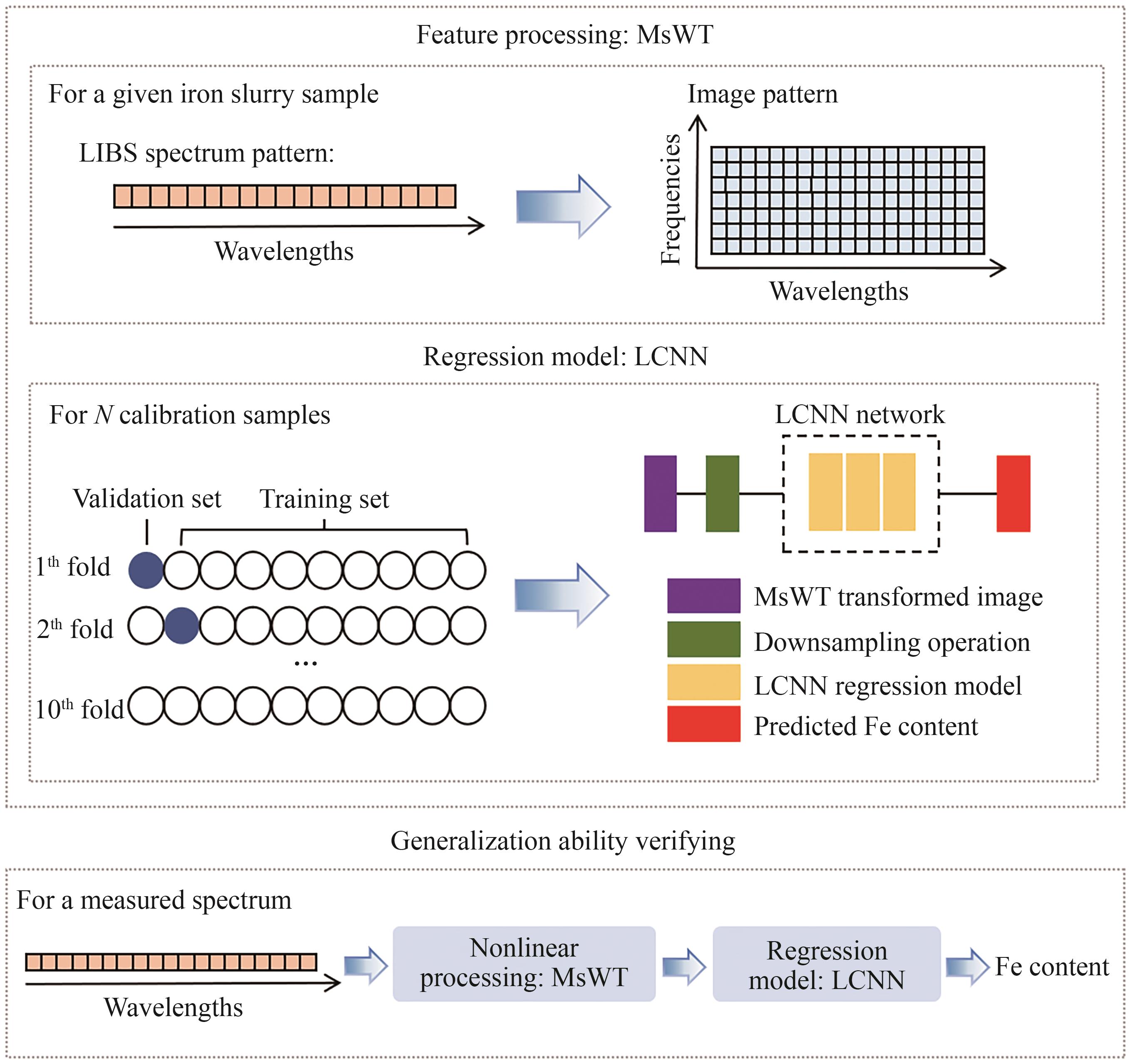
图5 MsWT-LCNN方法的示意图[25]
Fig.5 Schematic diagram of the MsWT-LCNN method[25]
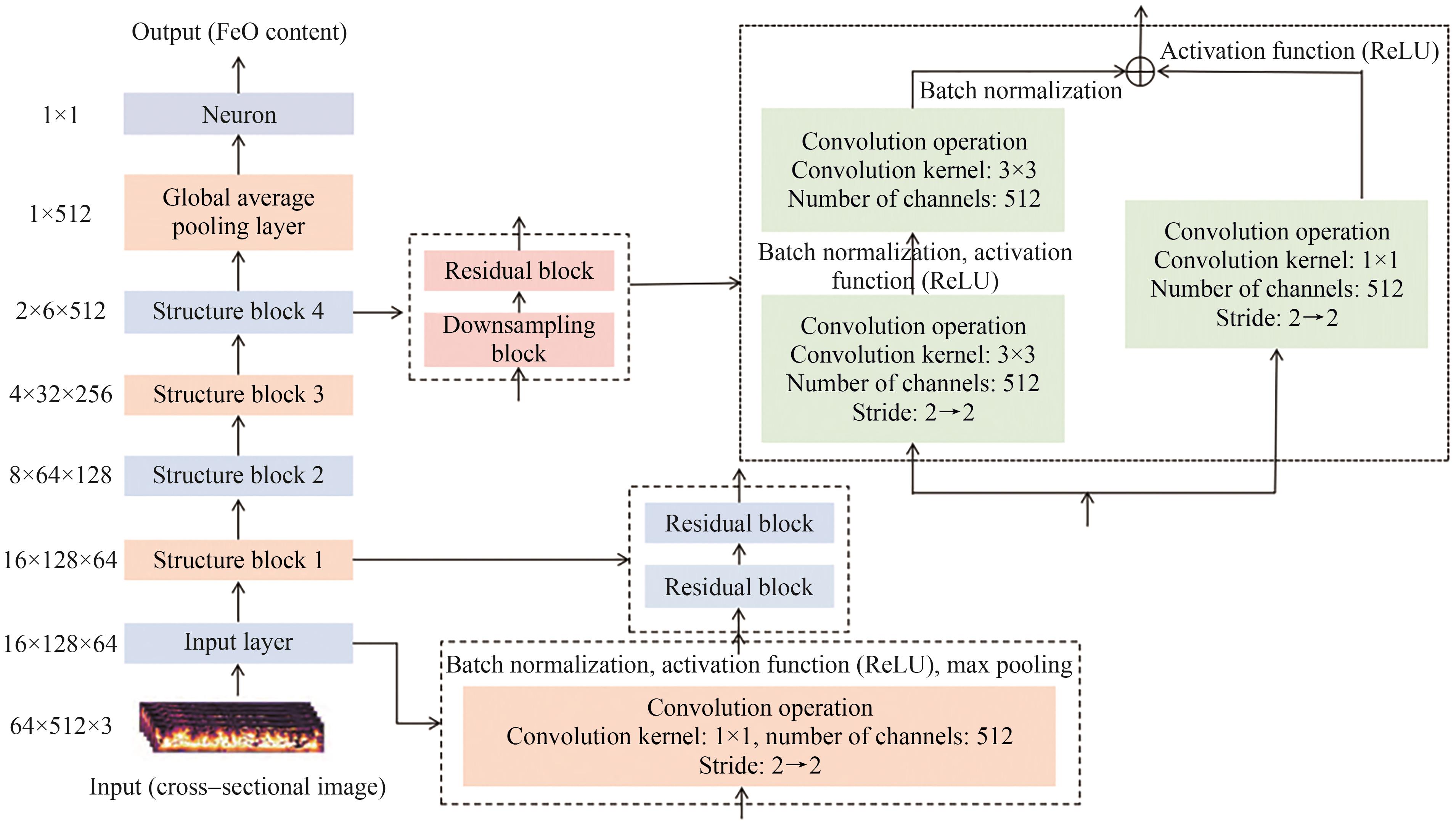
图6 改进ResNet-18网络结构[34]
Fig.6 Improved ResNet-18 network structure[34]
| Model method | Model advantages and disadvantages | Ref. |
|---|---|---|
| Image recognition+fuzzy classification | Accurate FeO determination with 85% hit rate; sensitive to site interference and material variations | [ |
| Infrared thermography+a three-layer BP neural network | Monitors FeO content with stability improving from 84% to 92% within ±1.0%; becomes unstable above 60℃ | [ |
| Improved ResNet-18 prediction model | Achieves 91.2% hit rate within ±0.5%; slightly lower training accuracy than original ResNet-18 | [ |
| Improved Darknet-19 model+time-window statistics | Enables online sensing and adaptive learning of FeO; accuracy within ±0.5% is 82.5% | [ |
| Bi-LSTM+MIV feature selection | Achieves 90.2% accuracy within ±8%; predictions are indirect and lack interpretability | [ |
表1 基于红外热像的烧结矿FeO含量预测方法对比
Table 1 Comparison of infrared-based FeO content prediction methods
| Model method | Model advantages and disadvantages | Ref. |
|---|---|---|
| Image recognition+fuzzy classification | Accurate FeO determination with 85% hit rate; sensitive to site interference and material variations | [ |
| Infrared thermography+a three-layer BP neural network | Monitors FeO content with stability improving from 84% to 92% within ±1.0%; becomes unstable above 60℃ | [ |
| Improved ResNet-18 prediction model | Achieves 91.2% hit rate within ±0.5%; slightly lower training accuracy than original ResNet-18 | [ |
| Improved Darknet-19 model+time-window statistics | Enables online sensing and adaptive learning of FeO; accuracy within ±0.5% is 82.5% | [ |
| Bi-LSTM+MIV feature selection | Achieves 90.2% accuracy within ±8%; predictions are indirect and lack interpretability | [ |
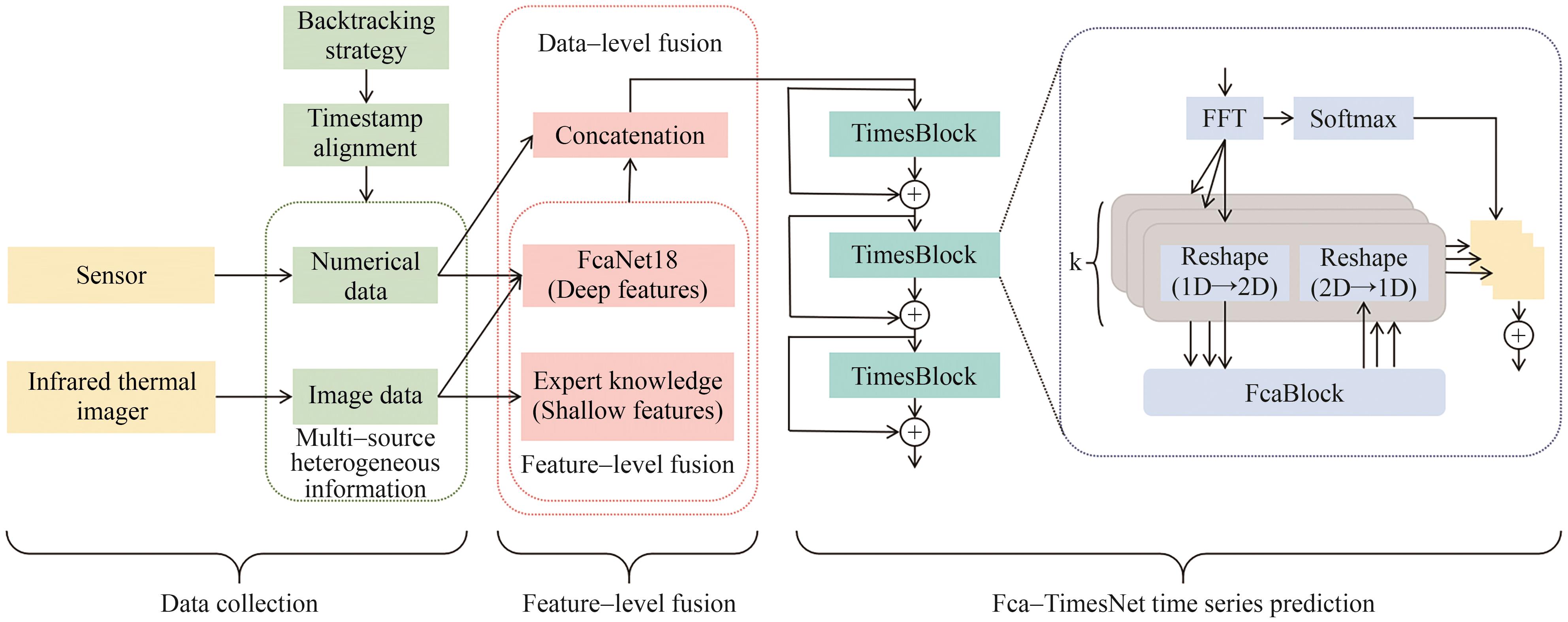
图7 FeO预测的多源数据融合与时序模型架构图[40]
Fig.7 Architecture diagram of multi-source fusion and temporal model for FeO prediction[40]
| Sensing technology | Advantage | Disadvantage | Applicability |
|---|---|---|---|
| PGNAA | Non-destructive; simultaneous multi-element analysis | Susceptible to environmental interference; high cost and complexity | For multi-element monitoring and closed-loop control of sinter mix composition |
| LIBS | Minimal sample preparation; qualitative & quantitative multi-element analysis | Matrix effects and self-absorption limit quantitative accuracy | For rapid laboratory screening or offline spot analysis of sinter products |
| NIR | High reproducibility; real-time monitoring of specific components | Reliant on calibration models; insensitive to traces | For online monitoring of moisture and carbon content in the sintering mix |
| Sinter end image analysis | High-precision, non-contact FeO estimation; automated | Limited to FeO; poor generalization and interpretability | For online estimation of FeO as an indicator of sinter end-point and quality |
表2 烧结物料成分感知技术对比
Table 2 Comparison of sintering materials composition sensing technologies
| Sensing technology | Advantage | Disadvantage | Applicability |
|---|---|---|---|
| PGNAA | Non-destructive; simultaneous multi-element analysis | Susceptible to environmental interference; high cost and complexity | For multi-element monitoring and closed-loop control of sinter mix composition |
| LIBS | Minimal sample preparation; qualitative & quantitative multi-element analysis | Matrix effects and self-absorption limit quantitative accuracy | For rapid laboratory screening or offline spot analysis of sinter products |
| NIR | High reproducibility; real-time monitoring of specific components | Reliant on calibration models; insensitive to traces | For online monitoring of moisture and carbon content in the sintering mix |
| Sinter end image analysis | High-precision, non-contact FeO estimation; automated | Limited to FeO; poor generalization and interpretability | For online estimation of FeO as an indicator of sinter end-point and quality |
| Detection method | Advantage | Disadvantage | Applicability |
|---|---|---|---|
| Neutron method | Non-contact, fast response, not affected by color or morphology | Radioactive, potential safety hazards | Suitable for high-precision detection under laboratory conditions |
| Microwave method | Non-contact, fast response | Sensitive to changes in material composition | Suitable for production environments where material composition is relatively stable |
| Near-infrared spectroscopy | Non-contact, fast response, high detection accuracy | Easily affected by material color and water vapor | Applicable to various sintering production lines, but environmental interference must be controlled |
表3 烧结混合料水分在线检测方法对比
Table 3 Comparison of online detection methods for sintering mix moisture
| Detection method | Advantage | Disadvantage | Applicability |
|---|---|---|---|
| Neutron method | Non-contact, fast response, not affected by color or morphology | Radioactive, potential safety hazards | Suitable for high-precision detection under laboratory conditions |
| Microwave method | Non-contact, fast response | Sensitive to changes in material composition | Suitable for production environments where material composition is relatively stable |
| Near-infrared spectroscopy | Non-contact, fast response, high detection accuracy | Easily affected by material color and water vapor | Applicable to various sintering production lines, but environmental interference must be controlled |
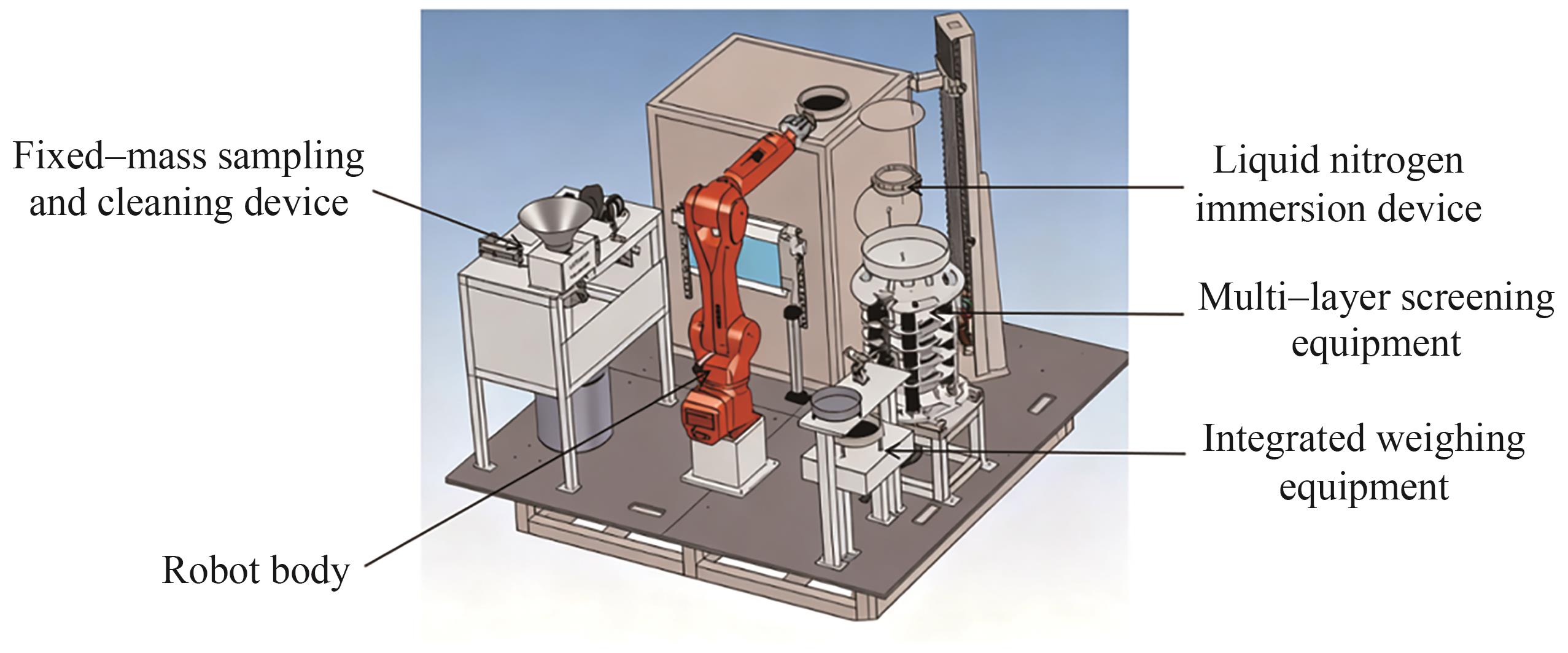
图8 机器人检测主机三维示意图[46]
Fig.8 3D view of robot detection host[46]
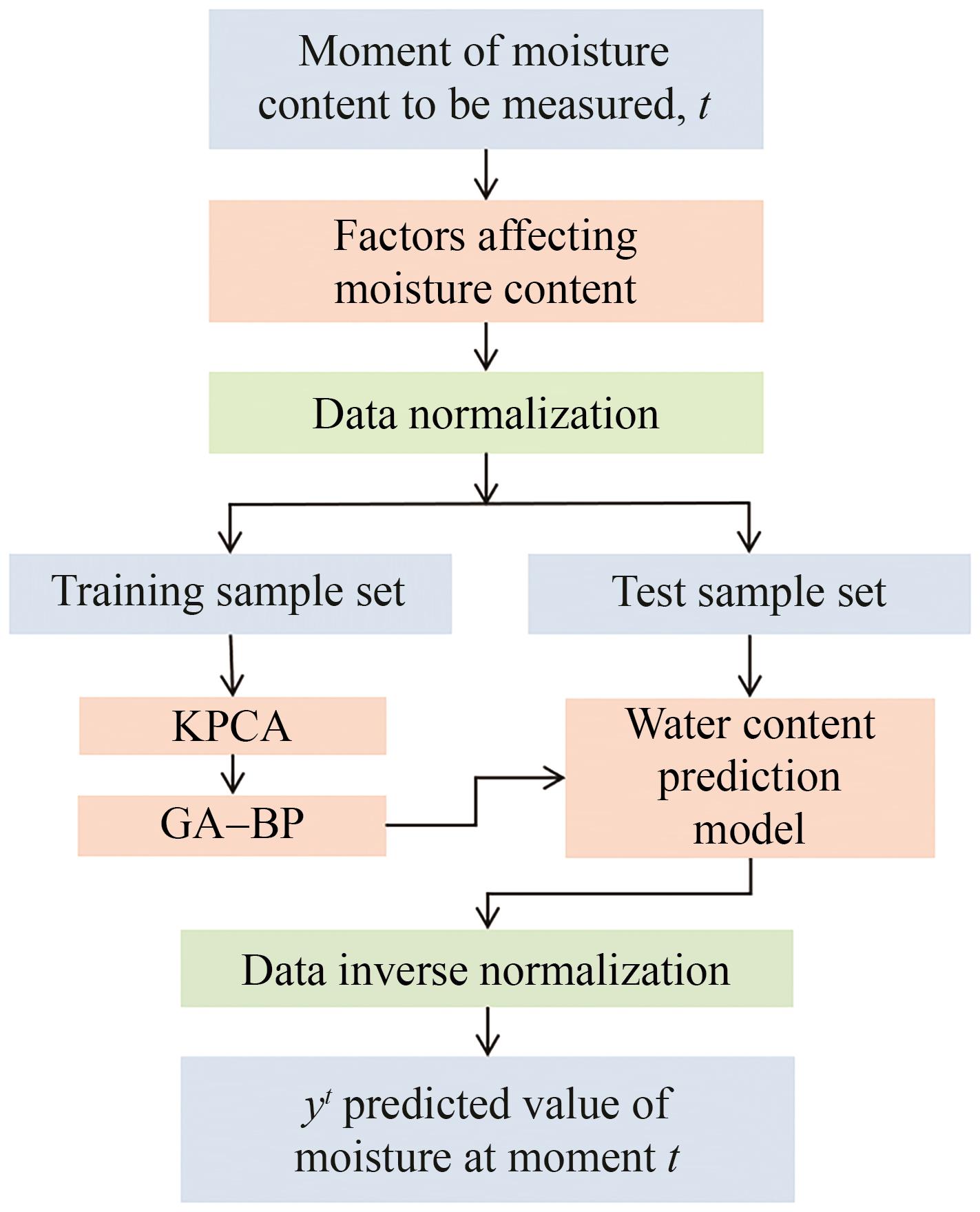
图9 水分预测策略步骤[51]
Fig.9 Moisture prediction strategy steps[51]
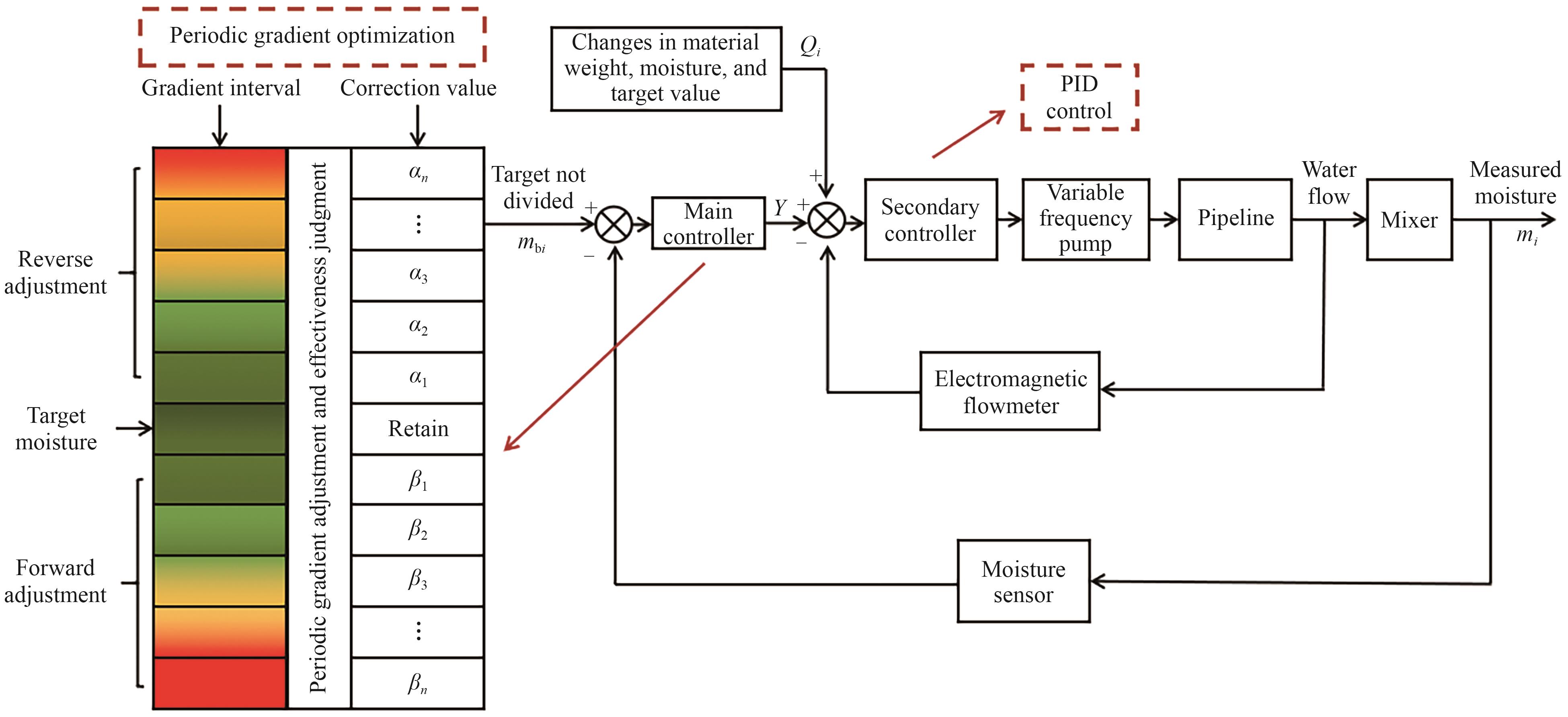
图10 周期梯度寻优控制策略的控制结构[54]
Fig.10 Control structure of periodic gradient optimization control strategy[54]
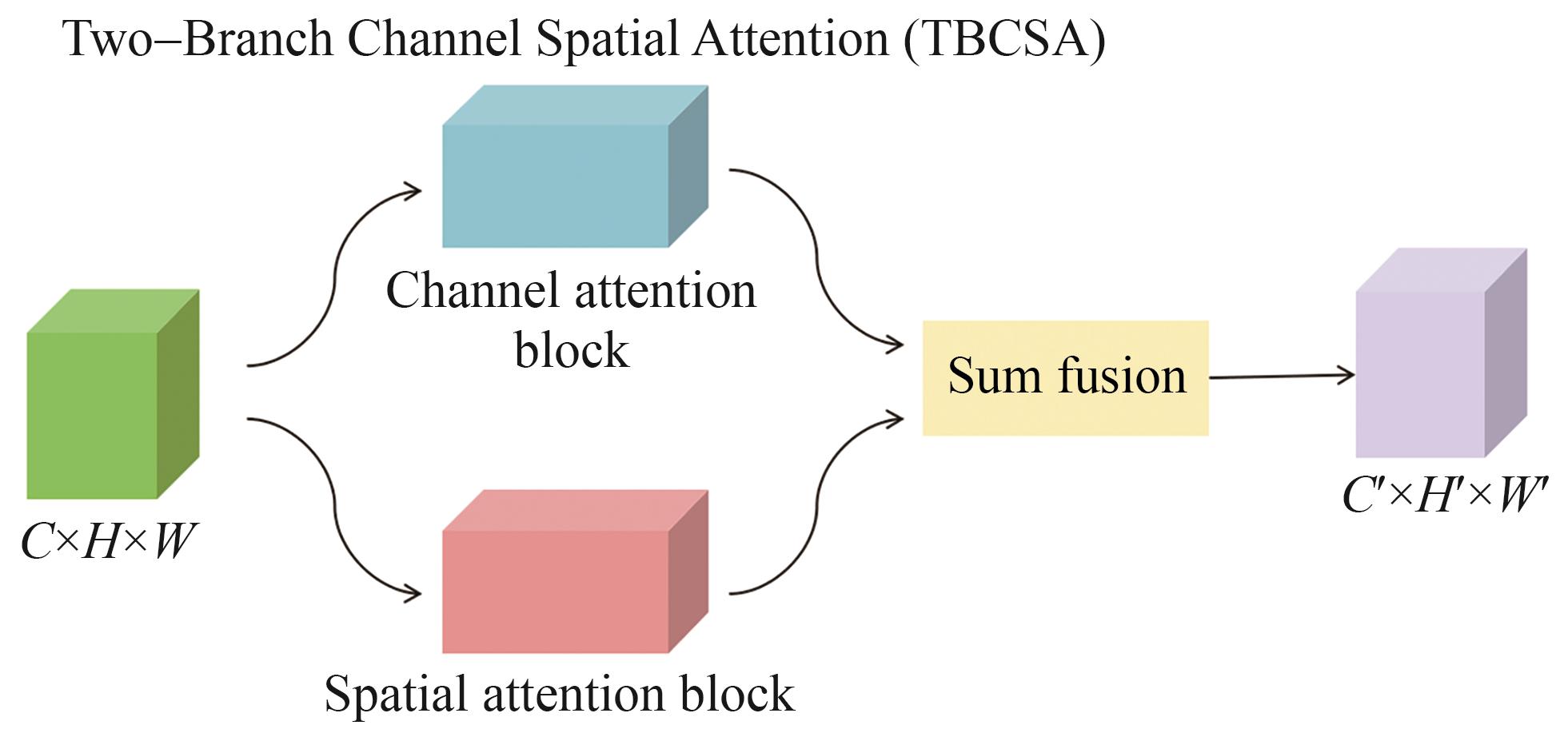
图11 双分支通道空间注意力模块[61]
Fig.11 Two-branch channel spatial attention module[61]
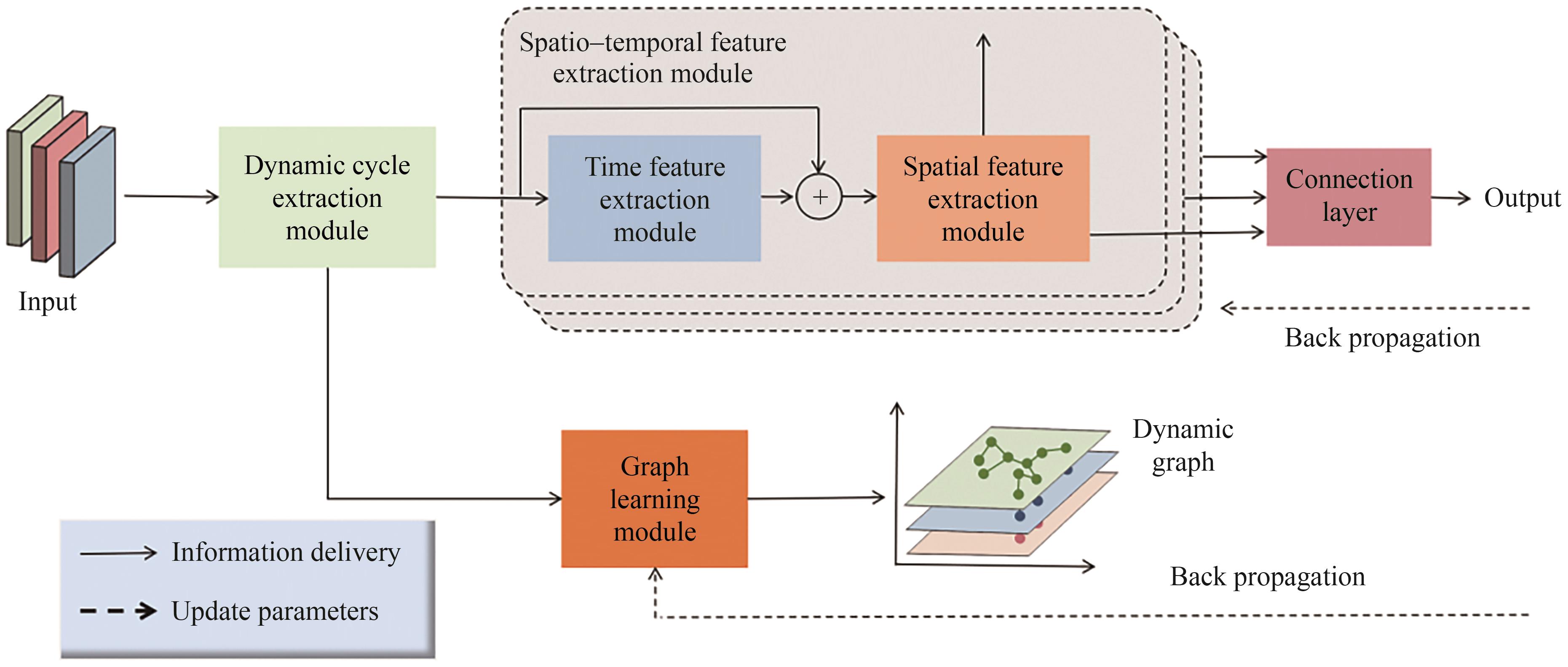
图12 基于动态图的烧结终点预测与控制结构[65]
Fig.12 BTP prediction and control structure based on dynamic graph[65]
| Main issue | Method | Key advantage | Ref. |
|---|---|---|---|
| Sintering endpoint is difficult to measure; BP network prone to local optima | GA-PSO optimized BP neural network model | Prediction accuracy superior to BP, GA-BP, and PSO-BP; significant error reduction | [ |
| Difficult to achieve fast and accurate modeling for sintering endpoint prediction | BP neural network-based prediction model | Fast training, low error, and adjustable parameters | [ |
| Missing key process parameters; slow training; prone to local extrema | Improved AdaBoost.RS extreme learning machine ensemble algorithm | Hit rate 97.4%, RMSE 0.58; quantifies key influencing factors | [ |
| Non-stationary and nonlinear data makes endpoint prediction difficult | CNN-Bi-LSTM fusion prediction model | The model achieved a goodness-of-fit of 0.89, with high prediction accuracy | [ |
| Traditional BTP prediction insufficient for complex reaction mechanisms and dynamic behavior; limited accuracy | Digital twin-driven DT-SVR/DT-LSTM | DT-SVR: RMSE reduced by 29%, R2 increased by 34%; DT-LSTM: RMSE reduced by 41%, R2 increased by 16% | [ |
| Traditional endpoint prediction models lack feature selection; limited accuracy | Feature selection using big data warehouse+process knowledge; GBDT modeling combined with expert rules | Prediction hit rate >88%; improved accuracy and generalization | [ |
| Feature redundancy reduces prediction accuracy; single learners prone to overfitting; ensemble model scale too large | Genetic algorithm for feature selection+RVFLNs ensemble modeling+sparse representation pruning | Pruning improves computational efficiency and model stability | [ |
| Intelligent control of sintering endpoint is difficult; multi-parameter but few labels | Multimodal large model (DeepSeek)+transfer learning+multi-objective optimization | High accuracy, strong robustness, enables dynamic optimization control | [ |
| Endpoint prediction ignores spatiotemporal characteristics; only single-step prediction | Encoder-decoder multi-step prediction model (temporal convolution+spatial attention+task decoder) | Captures spatiotemporal features, enables multi-step prediction, improves operational adjustment accuracy and sinter quality stability | [ |
| Prediction affected by multiple operating conditions and time-varying factors; model performance insufficient | XGBoost local model under online learning framework+KL-divergence-based similar sample selection | Improves prediction accuracy and adapts to multiple operating conditions in a reasonable time | [ |
表4 烧结终点预测方法对比
Table 4 Comparison of BTP prediction methods
| Main issue | Method | Key advantage | Ref. |
|---|---|---|---|
| Sintering endpoint is difficult to measure; BP network prone to local optima | GA-PSO optimized BP neural network model | Prediction accuracy superior to BP, GA-BP, and PSO-BP; significant error reduction | [ |
| Difficult to achieve fast and accurate modeling for sintering endpoint prediction | BP neural network-based prediction model | Fast training, low error, and adjustable parameters | [ |
| Missing key process parameters; slow training; prone to local extrema | Improved AdaBoost.RS extreme learning machine ensemble algorithm | Hit rate 97.4%, RMSE 0.58; quantifies key influencing factors | [ |
| Non-stationary and nonlinear data makes endpoint prediction difficult | CNN-Bi-LSTM fusion prediction model | The model achieved a goodness-of-fit of 0.89, with high prediction accuracy | [ |
| Traditional BTP prediction insufficient for complex reaction mechanisms and dynamic behavior; limited accuracy | Digital twin-driven DT-SVR/DT-LSTM | DT-SVR: RMSE reduced by 29%, R2 increased by 34%; DT-LSTM: RMSE reduced by 41%, R2 increased by 16% | [ |
| Traditional endpoint prediction models lack feature selection; limited accuracy | Feature selection using big data warehouse+process knowledge; GBDT modeling combined with expert rules | Prediction hit rate >88%; improved accuracy and generalization | [ |
| Feature redundancy reduces prediction accuracy; single learners prone to overfitting; ensemble model scale too large | Genetic algorithm for feature selection+RVFLNs ensemble modeling+sparse representation pruning | Pruning improves computational efficiency and model stability | [ |
| Intelligent control of sintering endpoint is difficult; multi-parameter but few labels | Multimodal large model (DeepSeek)+transfer learning+multi-objective optimization | High accuracy, strong robustness, enables dynamic optimization control | [ |
| Endpoint prediction ignores spatiotemporal characteristics; only single-step prediction | Encoder-decoder multi-step prediction model (temporal convolution+spatial attention+task decoder) | Captures spatiotemporal features, enables multi-step prediction, improves operational adjustment accuracy and sinter quality stability | [ |
| Prediction affected by multiple operating conditions and time-varying factors; model performance insufficient | XGBoost local model under online learning framework+KL-divergence-based similar sample selection | Improves prediction accuracy and adapts to multiple operating conditions in a reasonable time | [ |
| Company | Nangang | Pangang | Angang | Laigang | Tanggang | Baogang |
|---|---|---|---|---|---|---|
| Effective area/m2 | 360 | 260 | 360 | 265 | 360 | 600 |
| Air leakage rate/% | 53.4 | 46.67 | 46.5 | 45.8 | 41.57 | 35.25 |
表5 部分钢铁企业烧结机漏风率
Table 5 Leakage rates of sintering machines at selected steel plants
| Company | Nangang | Pangang | Angang | Laigang | Tanggang | Baogang |
|---|---|---|---|---|---|---|
| Effective area/m2 | 360 | 260 | 360 | 265 | 360 | 600 |
| Air leakage rate/% | 53.4 | 46.67 | 46.5 | 45.8 | 41.57 | 35.25 |
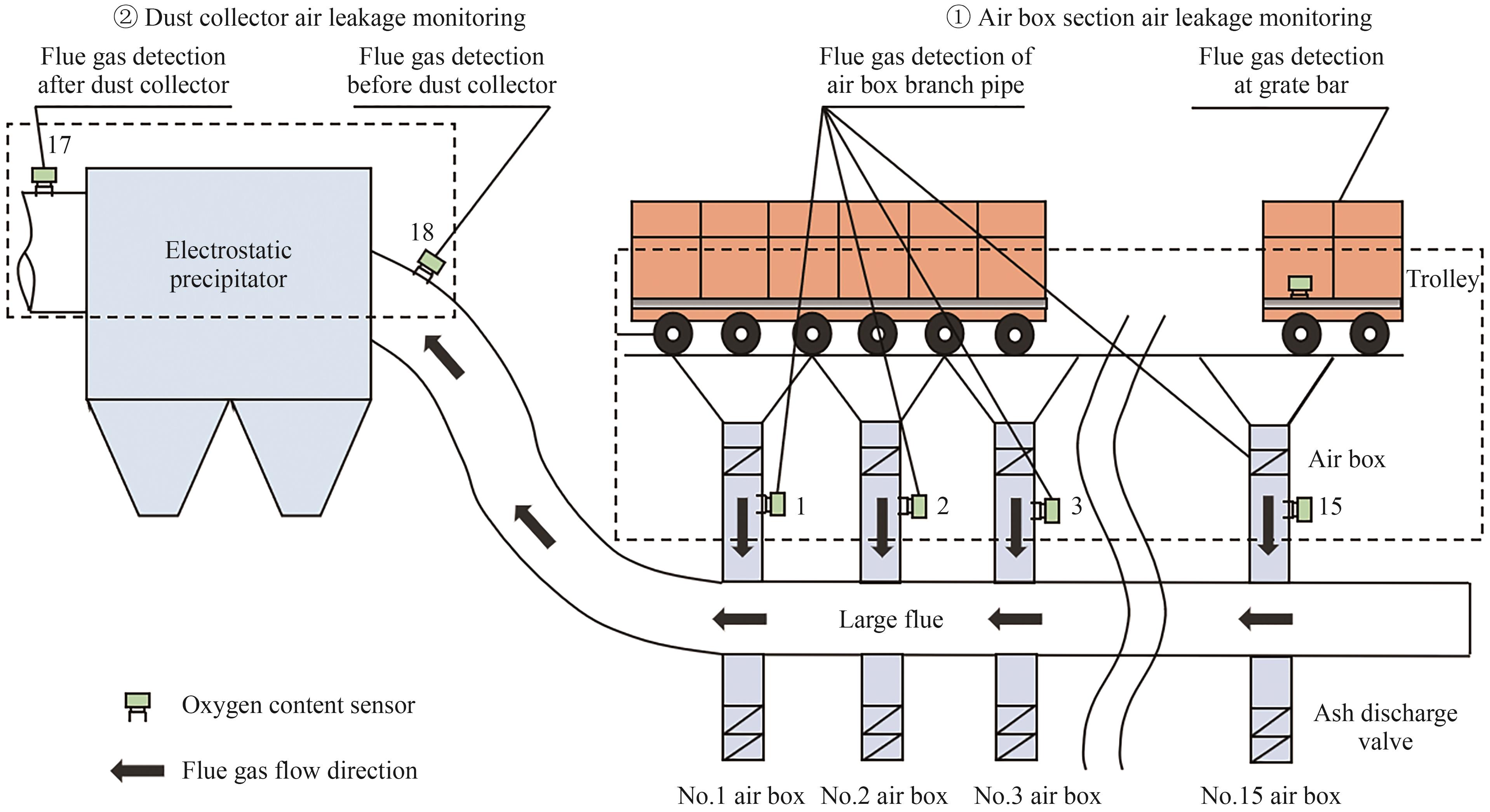
图13 在线漏风监测系统的设计方案[78]
Fig.13 Online leakage monitoring system design[78]
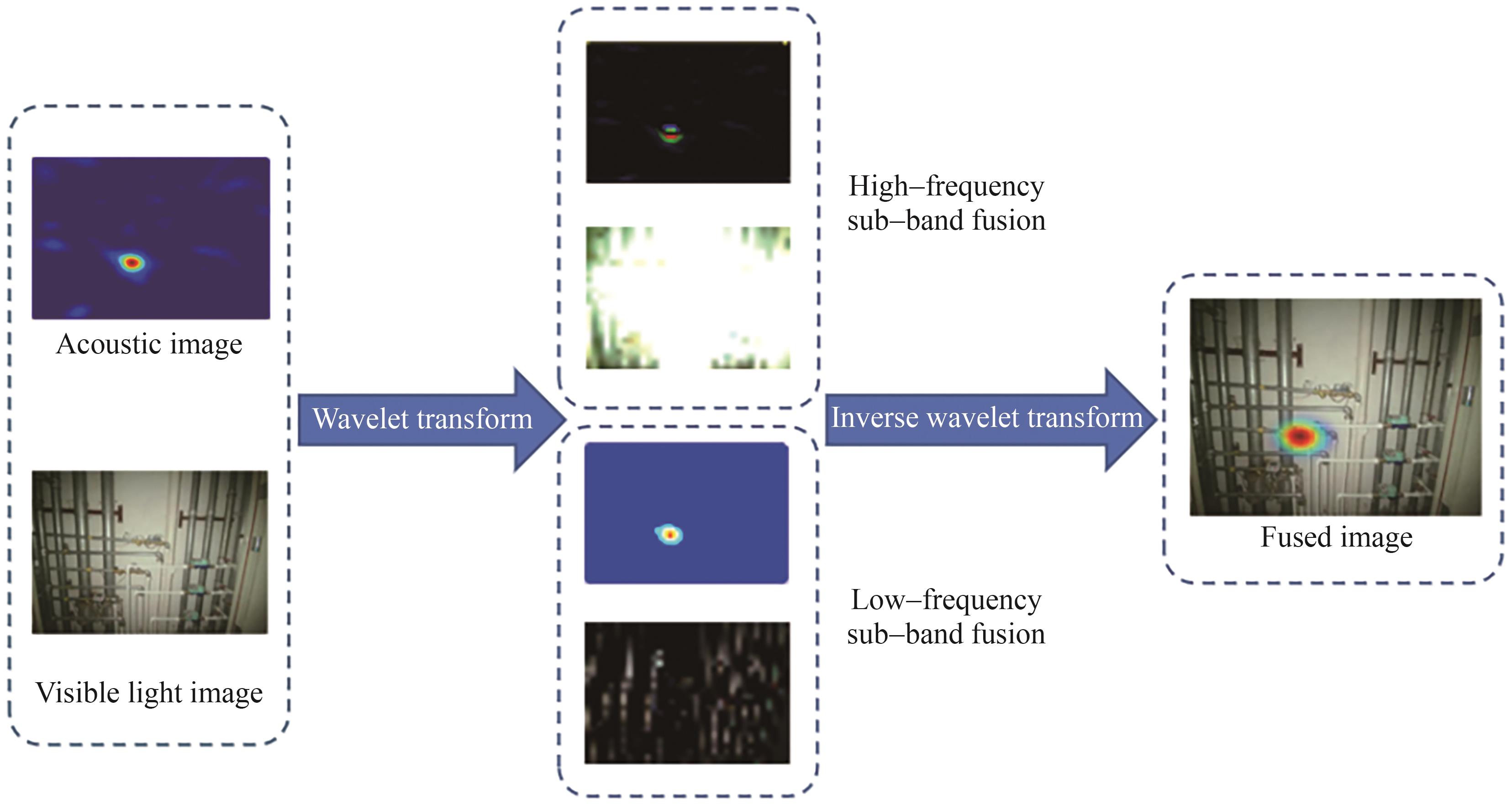
图14 基于MSA的声学图像和可见光图像融合算法实现过程[81]
Fig.14 Implementation process of acoustic image and visible light image fusion algorithm based on MSA[81]
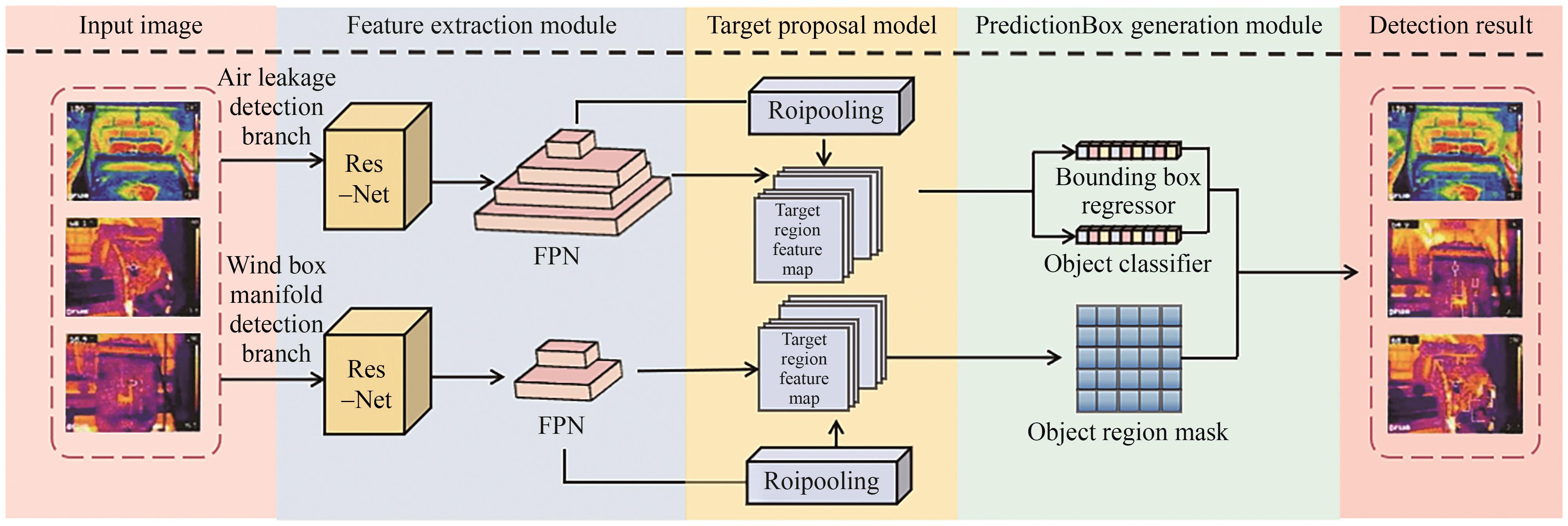
图15 风箱漏风点检测算法网络结构[83]
Fig.15 Network structure of the wind box air leakage detection algorithm[83]
| [1] | 杜胜, 陈聪, 胡杰, 等. 钢铁冶金过程铁前工序绿色智能制造的进展与展望 [J]. 冶金自动化, 2022, 46(2): 3-18. |
| Du S, Chen C, Hu J, et al. Progress and prospect of green intelligent manufacturing in ironmaking processes of steel metallurgy [J]. Metallurgical Automation, 2022, 46(2): 3-18. | |
| [2] | 韩旭. 基于LIBS的烧结矿碱度分析技术开发 [D]. 吉林: 吉林大学, 2019: 49-63. |
| Han X. Development of sinter basicity analysis technology based on LIBS [D]. Jilin: Jilin University, 2019: 49-63. | |
| [3] | 丁成义, 常仁德, 郭胜兰, 等. 烧结过程智能控制及烧结矿冶金性能预测研究现状 [J]. 钢铁, 2024, 59(4): 42-56. |
| Ding C Y, Chang R D, Guo S L, et al. Research status of intelligent control of sintering process and prediction of metallurgical properties of sinter [J]. Iron and Steel, 2024, 59(4): 42-56. | |
| [4] | 王冠, 焦礼静, 王惠明, 等. 钢铁行业智能制造技术发展现状 [J]. 环境工程, 2020, 38(12): 173-176, 137. |
| Wang G, Jiao L J, Wang H M, et al. Development status of intelligent manufacturing technology in steel industry [J]. Environmental Engineering, 2020, 38(12): 173-176, 137. | |
| [5] | 安剑奇, 郭云鹏, 张新民, 等. 高炉炼铁过程智能感知、诊断与控制方法的研究现状与展望 [J]. 冶金自动化, 2024, 48(2): 2-23. |
| An J Q, Guo Y P, Zhang X M, et al. Research status and prospect of intelligent sensing, diagnosis and control methods for blast furnace ironmaking process [J]. Metallurgical Automation, 2024, 48(2): 2-23. | |
| [6] | Luo Y Y, Zhang X M, Manabu K, et al. Data-driven soft sensors in blast furnace ironmaking: a survey [J]. Frontiers of Information Technology & Electronic Engineering, 2023, 24(3): 327-354. |
| [7] | 林天闻, 王彩云, 李英敏, 等. X射线荧光光谱分析铁矿石技术的进展 [J]. 冶金分析, 2024, 44(6): 30-43. |
| Lin T W, Wang C Y, Li Y M, et al. Progress in X-ray fluorescence spectrometry for iron ore analysis [J]. Metallurgical Analysis, 2024, 44(6): 30-43. | |
| [8] | 李福民, 侯炬才, 刘小杰, 等. 烧结系统智能制造的发展现状与展望 [J]. 烧结球团, 2024, 49(1): 27-34. |
| Li F M, Hou J C, Liu X J, et al. Development status and prospect of intelligent manufacturing in sintering system [J]. Sintering and Pelletizing, 2024, 49(1): 27-34. | |
| [9] | 金明芳, 朱道飞, 郑忠, 等. 铁矿石粉矿成分对烧结强度的影响 [J]. 东北大学学报(自然科学版), 2009, 30(1): 86-89. |
| Jin M F, Zhu D F, Zheng Z, et al. Effect of iron ore powder composition on sinter strength [J]. Journal of Northeastern University (Natural Science), 2009, 30(1): 86-89. | |
| [10] | 唐艳云, 代梦博, 春铁军, 等. 成分在线检测技术进展及其在铁矿烧结应用趋势 [J]. 烧结球团, 2021, 46(3): 1-8, 58. |
| Tang Y Y, Dai M B, Chun T J, et al. Progress of online composition detection technology and its application trend in iron ore sintering [J]. Sintering and Pelletizing, 2021, 46(3): 1-8, 58. | |
| [11] | 程璨, 黑大千, 贾文宝, 等. 基于瞬发伽马中子活化分析技术的金属样品检测研究 [J]. 光谱学与光谱分析, 2022, 42(6): 1928-1933. |
| Cheng C, Hei D Q, Jia W B, et al. Study on metal sample detection based on prompt Gamma neutron activation analysis [J]. Spectroscopy and Spectral Analysis, 2022, 42(6): 1928-1933. | |
| [12] | Peng K, Yang J, Tuo X, et al.Research on PGNAA adaptive analysis method with BP neural network [J]. Modern Physics Letters B, 2016, 30(32/33): 10. |
| [13] | Cao J, Zhong G C, You T H, et al.High-precision copper-grade identification via a vision transformer with PGNAA [J]. Nuclear Science and Techniques, 2025, 36(7): 120. |
| [14] | Huang H, Cai P, Liang X, et al.Online analysis of iron ore slurry using PGNAA technology with artificial neural network [J]. Nuclear Engineering and Technology, 2024, 56(7): 2835-2841. |
| [15] | 袁致强. 基于深度置信网络的烧结矿化学成分预测模型研究 [D]. 武汉: 武汉科技大学, 2018. |
| Yuan Z Q. Research on prediction model of sinter chemical composition based on deep belief network [D]. Wuhan: Wuhan University of Science and Technology, 2018. | |
| [16] | 甘牧原, 李宗社, 刘巍, 等. 在线成分测控系统在柳钢烧结生产的应用实践 [J]. 烧结球团, 2018, 43(3): 32-36. |
| Gan M Y, Li Z S, Liu W, et al. Application of online composition measurement and control system in Liuzhou Steel sintering production [J]. Sintering and Pelletizing, 2018, 43(3): 32-36. | |
| [17] | 赵龙, 宋青锋, 张伟. 烧结矿碱度自动控制技术及应用 [J]. 科技创新与应用, 2023, 13(22): 154-157. |
| Zhao L, Song Q F, Zhang W. Automatic control technology and application of sinter basicity [J]. Technology Innovation and Application, 2023, 13(22): 154-157. | |
| [18] | 牛广辉, 张业建, 林庆宇. 激光诱导击穿光谱(LIBS)技术在低碳钢铁冶金行业的应用 [J]. 中国无机分析化学, 2024, 14(2): 168-175. |
| Niu G H, Zhang Y J, Lin Q Y. Application of LIBS technology in low-carbon steel metallurgy industry [J]. Chinese Journal of Inorganic Analytical Chemistry, 2024, 14(2): 168-175. | |
| [19] | 孙兰香, 汪为, 张鹏, 等. 激光诱导击穿光谱在冶金在线分析中的应用研究进展 [J]. 冶金分析, 2021, 41(12): 58-67. |
| Sun L X, Wang W, Zhang P, et al. Research progress on application of LIBS in metallurgical online analysis [J]. Metallurgical Analysis, 2021, 41(12): 58-67. | |
| [20] | 张容玲, 宋晨佳, 李又超, 等. 激光诱导击穿光谱结合化学计量学在冶金体系定量分析中的研究进展 [J]. 冶金分析, 2024, 44(10): 22-30. |
| Zhang R L, Song C J, Li Y C, et al. Progress in quantitative analysis of metallurgical systems by LIBS combined with chemometrics [J]. Metallurgical Analysis, 2024, 44(10): 22-30. | |
| [21] | Death D, Cunningham A, Pollard L. Multi-element analysis of iron ore pellets by laser-induced breakdown spectroscopy and principal components regression [J]. Spectrochimica Acta Part B: Atomic Spectroscopy, 2008, 63(7): 763-769. |
| [22] | 陈雨娟, 丁宇, 朱绍农, 等. 神经网络与激光诱导击穿光谱技术结合的烧结矿中硅元素定量分析方法探究 [J]. 冶金分析, 2021, 41(1): 24-29. |
| Chen Y J, Ding Y, Zhu S N, et al. Quantitative analysis of silicon in sinter by neural network combined with LIBS [J]. Metallurgical Analysis, 2021, 41(1): 24-29. | |
| [23] | 刘艳丽, 黄晓红, 安治国, 等. 基于激光诱导击穿光谱的废钢元素定量分析 [J]. 河北冶金, 2022, (9): 29-33, 46. |
| Liu Y L, Huang X H, An Z G, et al. Quantitative analysis of scrap steel elements by LIBS [J]. Hebei Metallurgy, 2022, (9): 29-33, 46. | |
| [24] | Duan C, Huang Z, Jin Y, et al. A combination of XGBoost and neural network in LIBS spectrum processing for precise determination of critical elements in 620 iron ore samples of various origins [J]. Spectrochimica Acta Part B: Atomic Spectroscopy, 2024, 221: 107056. |
| [25] | Chen T, Sun L X, Yu H B, et al. Online Fe grade monitoring of iron ore slurry by Morse wavelet transform and lightweight convolutional neural network based on LIBS [J]. Spectrochimica Acta Part B: Atomic Spectroscopy, 2023, 210: 106821. |
| [26] | 洪名瑶, 张雅馨, 仲峻松, 等. 近红外光谱技术在铁矿中的应用研究 [J]. 中国口岸科学技术, 2025, 7(4): 48-55. |
| Hong M Y, Zhang Y X, Zhong J S, et al. Application of near-infrared spectroscopy in iron ore [J]. China Port Science and Technology, 2025, 7(4): 48-55. | |
| [27] | Liu Z J, Li Z, Zhang J L, et al. Rapid, non-destructive identification of iron ores-based random forest (RF) using visible and near-infrared spectroscopy [J]. Metallurgical and Materials Transactions, 2024, 55(4): 2591-2600. |
| [28] | Xu M, Mao Y, Zhang M, et al. Rapid detection of iron ore and mining areas based on MSSA-BNVTELM, visible—infrared spectroscopy, and remote sensing [J]. Remote Sensing, 2023, 15(16): 4100. |
| [29] | Xie H F, Xiao D, Mao Z Z. Rapid detection of iron ore grades based on fractional-order derivative spectroscopy and machine learning [J]. IEEE Transactions on Instrumentation and Measurement, 2023, 72: 1-10. |
| [30] | Xiao D, Liu C M, Le T B. Detection method of TFe content of iron ore based on visible-infrared spectroscopy and IPSO-TELM neural network [J]. Infrared Physics and Technology, 2019, 97: 341-348. |
| [31] | Zhang X Y, Xiong D L, Xie M, et al. Research progress on prediction of FeO content in sinter based on intelligent algorithm [J]. Ironmaking & Steelmaking: Processes, Products and Applications, 2025, 53(6): 1255-1273. |
| [32] | 郑波. 400 m2烧结机机尾热像仪改造研究 [J]. 中国重型装备, 2019, (4): 33-34. |
| Zheng B. Research on retrofit of thermal imager at tail of 400 m2 sintering machine [J]. China Heavy Equipment, 2019, (4): 33-34. | |
| [33] | 刘旦.兴澄烧结机尾热成像系统应用 [J]. 今日自动化, 2021,(12): 35-36. |
| Liu D. Application of thermal imaging system at tail of Xingcheng sintering machine [J]. Automation Today, 2021, (12): 35-36. | |
| [34] | 匡朝辉, 范晓慧, 赵利明, 等.烧结矿FeO含量在线智能检测系统开发与应用 [J]. 烧结球团, 2023, 48(6): 157-163. |
| Kuang Z H, Fan X H, Zhao L M, et al. Development and application of online intelligent detection system for FeO content in sinter [J]. Sintering and Pelletizing, 2023, 48(6): 157-163. | |
| [35] | 张石, 郑春清, 张宏勋, 等. 用图象识别法在线判断烧结矿FeO含量等级的研究 [J]. 钢铁, 1998, (5): 3-6, 10. |
| Zhang S, Zheng C Q, Zhang H X, et al. Study on online judgment of FeO content grade in sinter by image recognition [J]. Iron and Steel, 1998, (5): 3-6, 10. | |
| [36] | 马洛文. 基于机尾红外热图像的烧结矿质量监测 [J]. 炼铁, 2005, (S1): 107-110. |
| Ma L W. Quality monitoring of sinter based on infrared thermal images at machine tail [J]. Ironmaking, 2005, (S1): 107-110. | |
| [37] | 黄晓贤, 范晓慧, 陈许玲, 等. 基于机尾红外热成像的烧结矿FeO含量预测系统 [C]//2023全国冶金烧结绿色低碳关键技术研讨会论文集. 2023: 101-105. |
| Huang X X, Fan X H, Chen X L, et al. Prediction system of FeO content in sinter based on infrared thermal imaging at machine tail [C]//Proceedings of 2023 National Symposium on Green and Low-Carbon Key Technologies for Metallurgical Sintering. 2023: 101-105. | |
| [38] | 任玉辉, 曾小信, 李旭东. 基于机器视觉的烧结矿FeO含量在线感知 [J]. 烧结球团, 2024, 49(3): 53-59, 88. |
| Ren Y H, Zeng X X, Li X D. Online perception of FeO content in sinter based on machine vision [J]. Sintering and Pelletizing, 2024, 49(3): 53-59, 88. | |
| [39] | 张学锋, 闻亦昕, 熊大林, 等. 面向智能烧结的机尾断面烧结矿FeO预测研究 [J]. 钢铁研究学报, 2024, 36(5): 580-588. |
| Zhang X F, Wen Y X, Xiong D L, et al. FeO prediction of sinter at tail section for intelligent sintering [J]. Journal of Iron and Steel Research, 2024, 36(5): 580-588. | |
| [40] | 胡润琦, 何柏村, 杨冲, 等. 面向烧结工业的多源异构数据融合与实时感知技术 [J]. 冶金自动化, 2024, 48(6): 98-107. |
| Hu R Q, He B C, Yang C, et al. Multi-source heterogeneous data fusion and real-time sensing technology for sintering industry [J]. Journal of Iron and Steel Research, 2024, 36(5): 98-107. | |
| [41] | Yang C, Yang C J. Deep fusion of time series and visual data through temporal features: a soft-sensor model for FeO content in sintering process [J]. Expert Systems with Applications, 2025, 268: 126243. |
| [42] | 黄鼎堯, 黄晓贤, 向家发, 等. 基于TCN-DenseNet的烧结矿FeO含量预测 [J]. 河北冶金, 2024, (10): 14-19, 49. |
| Huang D Y, Huang X X, Xiang J F, et al. Prediction of FeO content in sinter based on TCN-DenseNet [J]. Hebei Metallurgy, 2024, (10): 14-19, 49. | |
| [43] | Zhou P, Gao B H, Zhao C H, et al. Heterogeneous data-driven measurement method for FeO content of sinter based on deep learning and tensor decomposition [J]. Control Engineering Practice, 2023, 134: 105479. |
| [44] | 刘昱钤, 潘冬, 蒋朝辉, 等. 钢铁制造烧结过程关键参数检测方法综述 [J]. 烧结球团, 2023, 48(6): 10-21. |
| Liu Y Q, Pan D, Jiang Z H, et al. Review of key parameter detection methods in steel manufacturing sintering process [J]. Sintering and Pelletizing, 2023, 48(6): 10-21. | |
| [45] | 信美华, 尹毅强, 孙小林. 基于微波原理的烧结混合料水分在线检测系统 [J]. 现代矿业, 2015, 31(12): 230-231, 236. |
| Xin M H, Yin Y Q, Sun X L. Online moisture detection system for sinter mixture based on microwave principle [J]. Modern Mining, 2015, 31(12): 230-231, 236. | |
| [46] | 曾小信, 李宗平, 过宇晟. 烧结混合料粒度及水分检测系统的研究与实现 [J]. 工程建设, 2023, 55(8): 69-73. |
| Zeng X X, Li Z P, Guo Y S. Research and implementation of particle size and moisture detection system for sinter mixture [J]. Engineering Construction, 2023, 55(8): 69-73. | |
| [47] | 马贤国, 杨学谦, 苟强源. 中子水分仪及其在烧结混合料水分控制中的应用 [J]. 烧结球团, 2012, 37(4): 27-29. |
| Ma X G, Yang X Q, Gou Q Y. Neutron moisture meter and its application in moisture control of sinter mixture [J]. Sintering and Pelletizing, 2012, 37(4): 27-29. | |
| [48] | 聂绍昌. 微波水分检测自动控制系统在新钢烧结生产中的应用 [J]. 江西冶金, 2018, 38(5): 17-21. |
| Nie S C. Application of microwave moisture detection automatic control system in Xingang sintering production [J]. Jiangxi Metallurgy, 2018, 38(5): 17-21. | |
| [49] | 别威, 王挽平, 李海东. 红外水分测控系统在烧结机上的应用 [J]. 河北冶金, 2016, (8): 38-41. |
| Bie W, Wang W P, Li H D. Application of infrared moisture measurement and control system on sintering machine [J]. Hebei Metallurgy, 2016, (8): 38-41. | |
| [50] | 彭梓塘. 基于数据驱动的烧结混合料水分优化研究 [D]. 长沙: 中南大学, 2023: 41-57. |
| Peng Z T. Research on moisture optimization of sinter mixture based on data-driven [D]. Changsha: Central South University, 2023: 41-57. | |
| [51] | Ren Y Q, Huang C Q, Jang Y S, et al. Neural network prediction model for sinter mixture water content based on KPCA-GA optimization [J]. Metals, 2022, 12(8): 1287. |
| [52] | 袁溢, 潘从元, 章新宇, 等. 基于SHAP可解释性分析与多特征融合的焦粉水分识别模型 [J]. 中国冶金, 2025, 35(7): 189-201. |
| Yuan Y, Pan C Y, Zhang X Y, et al. Moisture identification model for coke powder based on SHAP interpretability analysis and multi-feature fusion [J]. China Metallurgy, 2025, 35(7): 189-201. | |
| [53] | 刘俊. 烧结过程智能优化控制系统研究与开发 [D]. 杭州: 浙江大学, 2010: 43-61. |
| Liu J. Research and development of intelligent optimization control system for sintering process [D]. Hangzhou: Zhejiang University, 2010: 43-61. | |
| [54] | 王瑞林, 李自成, 熊涛, 等. 基于多级前馈与周期梯度寻优的烧结混合料水分控制方法 [J]. 烧结球团, 2023, 48(4): 38-45. |
| Wang R L, Li Z C, Xiong T, et al. Moisture control method for sinter mixture based on multi-level feedforward and periodic gradient optimization [J]. Sintering and Pelletizing, 2023, 48(4): 38-45. | |
| [55] | Shi R J, Cui M Y, Wang Y F, et al. Data driven sintering moisture control model based on neural network [J]. Journal of Physics: Conference Series, 2021, 1941(1): 012056. |
| [56] | Jiang Y S, Yang N, Yao Q Q, et al. Real-time moisture control in sintering process using offline-online NARX neural networks [J]. Neurocomputing, 2020, 396: 209-215. |
| [57] | 廖环宇. 烧结过程烧结终点智能控制策略及工业应用 [D]. 长沙: 中南大学, 2010: 15-44. |
| Liao H Y. Intelligent control strategy and industrial application of sintering end point in sintering process [D]. Changsha: Central South University, 2010: 15-44. | |
| [58] | 李屹, 王莹. 基于机器视觉的烧结终点识别方法研究 [J]. 冶金自动化, 2012, 36(6): 10-15. |
| Li Y, Wang Y. Research on sintering end point recognition method based on machine vision [J]. Metallurgical Automation, 2012, 36(6): 10-15. | |
| [59] | 曹玉鑫. 基于断面图像和风箱温度压力的烧结节能降耗系统研究 [D]. 天津: 南开大学, 2022: 33-60. |
| Cao Y X. Research on energy-saving and consumption-reducing system for sintering based on section image and wind box temperature and pressure [D]. Tianjin: Nankai University, 2022: 33-60. | |
| [60] | 安金铭. 基于数学形态学与卷积神经网络的烧结火焰图像分析 [D]. 唐山: 华北理工大学, 2023: 39-51. |
| An J M. Analysis of sintering flame images based on mathematical morphology and convolutional neural network [D]. Tangshan: North China University of Science and Technology, 2023: 39-51. | |
| [61] | 梁秀满, 安金铭, 曹晓华, 等. 基于改进MobileNetV3烧结断面火焰图像识别 [J]. 电子测量技术, 2023, 46(14): 182-187. |
| Liang X M, An J M, Cao X H, et al. Flame image recognition of sinter section based on improved MobileNetV3 [J]. Electronic Measurement Technology, 2023, 46(14): 182-187. | |
| [62] | 向齐良, 吴敏, 向婕, 等. 基于多元模糊线性回归的烧结终点预测方法 [J]. 控制工程, 2007, (6): 603-605, 617. |
| Xiang Q L, Wu M, Xiang J, et al. Prediction method of sintering end point based on multivariate fuzzy linear regression [J]. Control Engineering, 2007, (6): 603-605, 617. | |
| [63] | 张永敢, 蔡瑞英. 基于BFGS算法的BP网络在烧结终点预报中的应用 [J]. 微计算机信息, 2008, (34): 291-292, 280. |
| Zhang Y G, Cai R Y. Application of BP network based on BFGS algorithm in sintering end point prediction [J]. Microcomputer Information, 2008, (34): 291-292, 280. | |
| [64] | 石炜, 孙永涛, 秦波, 等. 基于粒子群优化径向基神经网络的烧结终点预测研究 [J]. 铸造技术, 2016, 37(11): 2479-2483. |
| Shi W, Sun Y T, Qin B, et al. Research on sintering end point prediction based on radial basis neural network optimized by particle swarm [J]. Foundry Technology, 2016, 37(11): 2479-2483. | |
| [65] | Chen X X, Liu C S, Xia H Z, et al. Burn-through point prediction and control based on multi-cycle dynamic spatio-temporal feature extraction [J]. Control Engineering Practice, 2025, 154: 106165. |
| [66] | 尹学. 烧结终点的智能控制研究与应用 [D]. 马鞍山: 安徽工业大学, 2020: 19-52. |
| Yin X. Research and application of intelligent control of sintering end point [D]. Ma'anshan: Anhui University of Technology, 2020: 19-52. | |
| [67] | 陈浩. 基于神经网络的烧结终点预测模型 [J]. 鞍钢技术, 2023, (4): 7-12, 16. |
| Chen H. Prediction model of sintering end point based on neural network [J]. Angang Technology, 2023, (4): 7-12, 16. | |
| [68] | 汪森辉, 李海峰, 张永杰, 等. 基于改进的AdaBoost.RS算法的烧结终点预报分析 [J]. 中国冶金, 2019, 29(10): 13-19. |
| Wang S H, Li H F, Zhang Y J, et al. Analysis of sintering end point prediction based on improved AdaBoost.RS algorithm [J]. China Metallurgy, 2019, 29(10): 13-19. | |
| [69] | 靳亚涛, 李宏扬, 刘小杰, 等. 基于大数据和机器学习的烧结终点预测 [J]. 冶金自动化, 2024, 48(S1): 101-105. |
| Jin Y T, Li H Y, Liu X J, et al. Prediction of sintering end point based on big data and machine learning [J]. Metallurgical Automation, 2024, 48(S1): 101-105. | |
| [70] | 曲鑫鹏, 杨春节, 孟劲松, 等. 数字孪生驱动的烧结终点预测方法 [J]. 冶金自动化, 2024, 48(S1): 12-17. |
| Qu X P, Yang C J, Meng J S, et al. Prediction method of sintering end point driven by digital twin [J]. Metallurgical Automation, 2024, 48(S1): 12-17. | |
| [71] | 赵志伟, 冯伟健, 邵玉杰, 等. 基于集成学习和工艺经验的烧结终点预报模型 [J]. 冶金能源, 2024, 43(3): 44-48. |
| Zhao Z W, Feng W J, Shao Y J, et al. Prediction model of sintering end point based on ensemble learning and process experience [J]. Metallurgical Energy, 2024, 43(3): 44-48. | |
| [72] | 周平, 吴忠卫, 张瑞垚, 等. 基于稀疏表示剪枝集成建模的烧结终点位置智能预测 [J]. 控制理论与应用, 2024, 41(3): 436-446. |
| Zhou P, Wu Z W, Zhang R Y, et al. Intelligent prediction of sintering end point location based on sparse representation pruning ensemble modeling [J]. Control Theory and Applications, 2024, 41(3): 436-446. | |
| [73] | 刘颂, 金焕, 刘然, 等. 借助多模态大模型的烧结终点优化模型 [J]. 钢铁, 2025, 60(9): 34-47. |
| Liu S, Jin H, Liu R, et al. Optimization model of sintering end point with multimodal large model [J]. Iron and Steel, 2025, 60(9): 34-47. | |
| [74] | 罗月阳, 何柏村, 张新民, 等. 基于时空编码任务解码的烧结终点多步预测方法研究 [J]. 冶金自动化, 2025, 49(2): 43-52. |
| Luo Y Y, He B C, Zhang X M, et al. Research on multi-step prediction method of sintering end point based on spatiotemporal encoding task decoding [J]. Metallurgical Automation, 2025, 49(2): 43-52. | |
| [75] | 王金杨, 吴朝霞, 李中正, 等. 基于JITL-XGBoost的烧结终点预测模型 [J]. 东北大学学报(自然科学版), 2025, 46(2): 28-34, 41. |
| Wang J Y, Wu Z X, Li Z Z, et al. Prediction model of sintering end point based on JITL-XGBoost [J]. Journal of Northeastern University (Natural Science), 2025, 46(2): 28-34, 41. | |
| [76] | 石光岳. 烧结机系统漏风的分析研究 [J]. 甘肃冶金, 2022, 44(4): 11-13. |
| Shi G Y. Analysis and research on air leakage of sintering machine system [J]. Gansu Metallurgy, 2022, 44(4): 11-13. | |
| [77] | 周明顺, 田勇, 赵东明, 等. 铁矿烧结系统漏风治理技术及评估综述 [J]. 中国冶金, 2024, 34(1): 1-9, 26. |
| Zhou M S, Tian Y, Zhao D M, et al. Review of air leakage control technology and evaluation for iron ore sintering system [J]. China Metallurgy, 2024, 34(1): 1-9, 26. | |
| [78] | 张安煜. 烧结机漏风控制技术研究 [D]. 青岛: 青岛大学, 2019: 17-46. |
| Zhang A Y. Research on air leakage control technology of sintering machine [D]. Qingdao: Qingdao University, 2019: 17-46. | |
| [79] | 陆伟文, 余文瑶, 张德千, 等. 烧结漏风在线监测系统开发与应用 [J]. 烧结球团, 2023, 48(6): 164-172. |
| Lu W W, Yu W Y, Zhang D Q, et al. Development and application of online monitoring system for sintering air leakage [J]. Sintering and Pelletizing, 2023, 48(6): 164-172. | |
| [80] | 孔祥虎. 烧结机本体泄漏的声压信号检测与实验研究 [D]. 沈阳: 东北大学, 2022: 21-66. |
| Kong X H. Detection and experimental study of sound pressure signal for sintering machine body leakage [D]. Shenyang: Northeastern University, 2022: 21-66. | |
| [81] | 李虎. 面向气体泄漏检测的视听融合成像系统研究 [D]. 绵阳:西南科技大学, 2024: 17-58. |
| Li H. Research on audio-visual fusion imaging system for gas leak detection [D]. Mianyang: Southwest University of Science and Technology, 2024: 17-58. | |
| [82] | 张余谦. 烧结机烧结过程数值模拟及其漏风检测研究 [D]. 沈阳: 东北大学, 2020: 51-63. |
| Zhang Y Q. Numerical simulation of sintering process and air leakage detection of sintering machine [D]. Shenyang: Northeastern University, 2020: 51-63. | |
| [83] | 时坤效. 基于图像处理的烧结机设备漏风点检测系统 [D]. 沈阳: 东北大学, 2022: 30-70. |
| Shi K X. Detection system for air leakage points of sintering machine equipment based on image processing [D]. Shenyang: Northeastern University, 2022: 30-70. |
| [1] | 冯康康 耿欣 娄清辉 王玉 胡华军 石祥建 薄翠梅. 基于数据驱动的乙二醇精馏过程能耗与产品质量建模[J]. 过程工程学报, 2025, 25(2): 142-149. |
| [2] | 张燕 王智慧 王倩 汪建明 王斌 惠锋基 丛威. 雷松藻消化的工艺条件[J]. 过程工程学报, 2016, 16(1): 144-150. |
| [3] | 何皓 蒋国强 齐泮仑 李顶杰 孙洪磊 付兴国. 提高微藻培养过程的光能转化率:工程途径及研究进展[J]. , 2013, 13(6): 1068-1074. |
| 阅读次数 | ||||||
|
全文 |
|
|||||
|
摘要 |
|
|||||

