

过程工程学报 ›› 2026, Vol. 26 ›› Issue (9): 987-997.DOI: 10.12034/j.issn.1009-606X.225306
赵建浩1( ), 王东祥1,2(), 袁方洋1, 杨新俊1, 杜继芸1, 于伟1
收稿日期:2025-12-09
修回日期:2026-02-11
出版日期:2026-03-19
发布日期:2026-09-28
通讯作者:
王东祥 2637481870@qq.com;dxwang@jiangnan.edu.cn
作者简介:赵建浩,硕士研究生,机械工程专业,E-mail: 2637481870@qq.com;基金资助:
Jianhao ZHAO1(), Dongxiang WANG1,2(), Fangyang YUAN1, Xinjun YANG1, Jiyun DU1, Wei YU1
Received:2025-12-09
Revised:2026-02-11
Online:2026-03-19
Published:2026-09-28
Contact:
Dongxiang WANG 2637481870@qq.com;dxwang@jiangnan.edu.cn
摘要:
气核双乳液是制备高性能中空微胶囊的关键前体,其尺寸和壳厚的精确调控是实现功能化应用的前提。针对微流控法制备过程中气核包封不稳定及壳厚难以独立调控的问题,本工作采用双流动聚焦微流控器件,在恒定供气压力下,系统研究了多相流参数对液滴形成动力学的影响。考察了油相黏度、流量比及外相表面张力等关键过程参数的影响,揭示了毛细管数与节点背压的耦合机制。研究发现,油相黏度和流量主要通过调节节点背压来控制气核体积,从而决定壳层厚度;而外相表面活性剂浓度则通过改变界面张力和外相毛细管数,主导液滴的剪切破碎过程。此外,基于实验数据,建立了一个包含毛细管数比和流量比的无量纲经验-物理混合模型,实现了对壳径比的定量预测。本研究阐明了气-油-水三相微流动过程中的流体动力学机理,为可控制备具有特定结构特征的中空微胶囊提供了理论指导和工艺设计依据。
中图分类号:
赵建浩, 王东祥, 袁方洋, 杨新俊, 杜继芸, 于伟. 基于背压-毛细管数协同效应的气核双乳液滴可控制备工艺[J]. 过程工程学报, 2026, 26(9): 987-997.
Jianhao ZHAO, Dongxiang WANG, Fangyang YUAN, Xinjun YANG, Jiyun DU, Wei YU. Controllable preparation process of gas core double emulsion droplets via synergistic effect of backpressure and capillary number[J]. The Chinese Journal of Process Engineering, 2026, 26(9): 987-997.
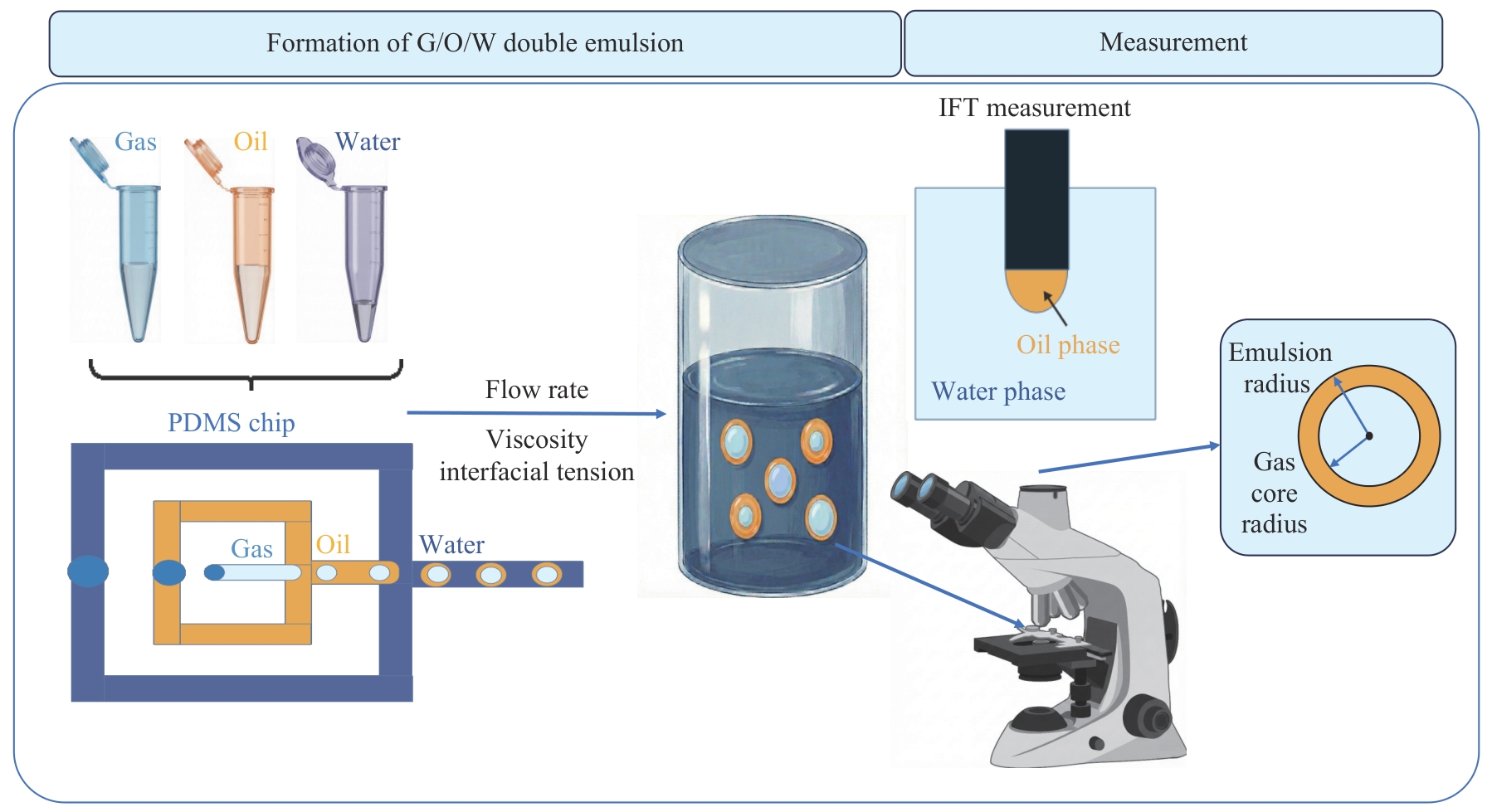
图1 G/O/W双乳液制备的实验流程
Fig.1 Experimental procedure for G/O/W double emulsion preparation
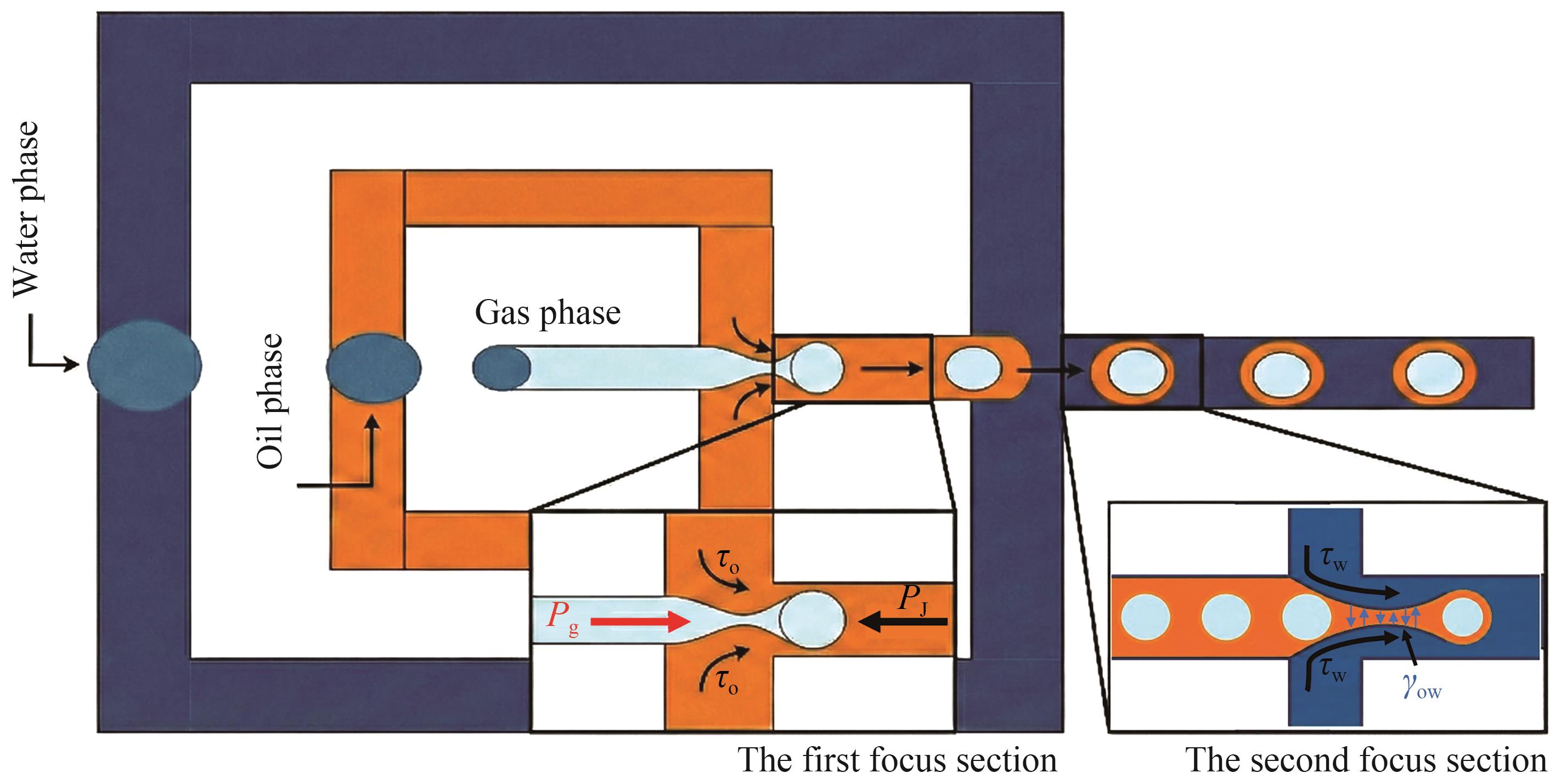
图2 气核双乳液形成过程中的力分析示意图
Fig.2 Schematic diagram of force analysis during the formation of gas core double emulsions
| Oil phase | 100wt% PDMS | 75wt% PDMS+25wt% silicone oil | 50wt% PDMS+50wt% silicone oil |
|---|---|---|---|
| μo/mPa·s | 280 | 195 | 62 |
表1 油相黏度
Table 1 Viscosity of the oil phase
| Oil phase | 100wt% PDMS | 75wt% PDMS+25wt% silicone oil | 50wt% PDMS+50wt% silicone oil |
|---|---|---|---|
| μo/mPa·s | 280 | 195 | 62 |
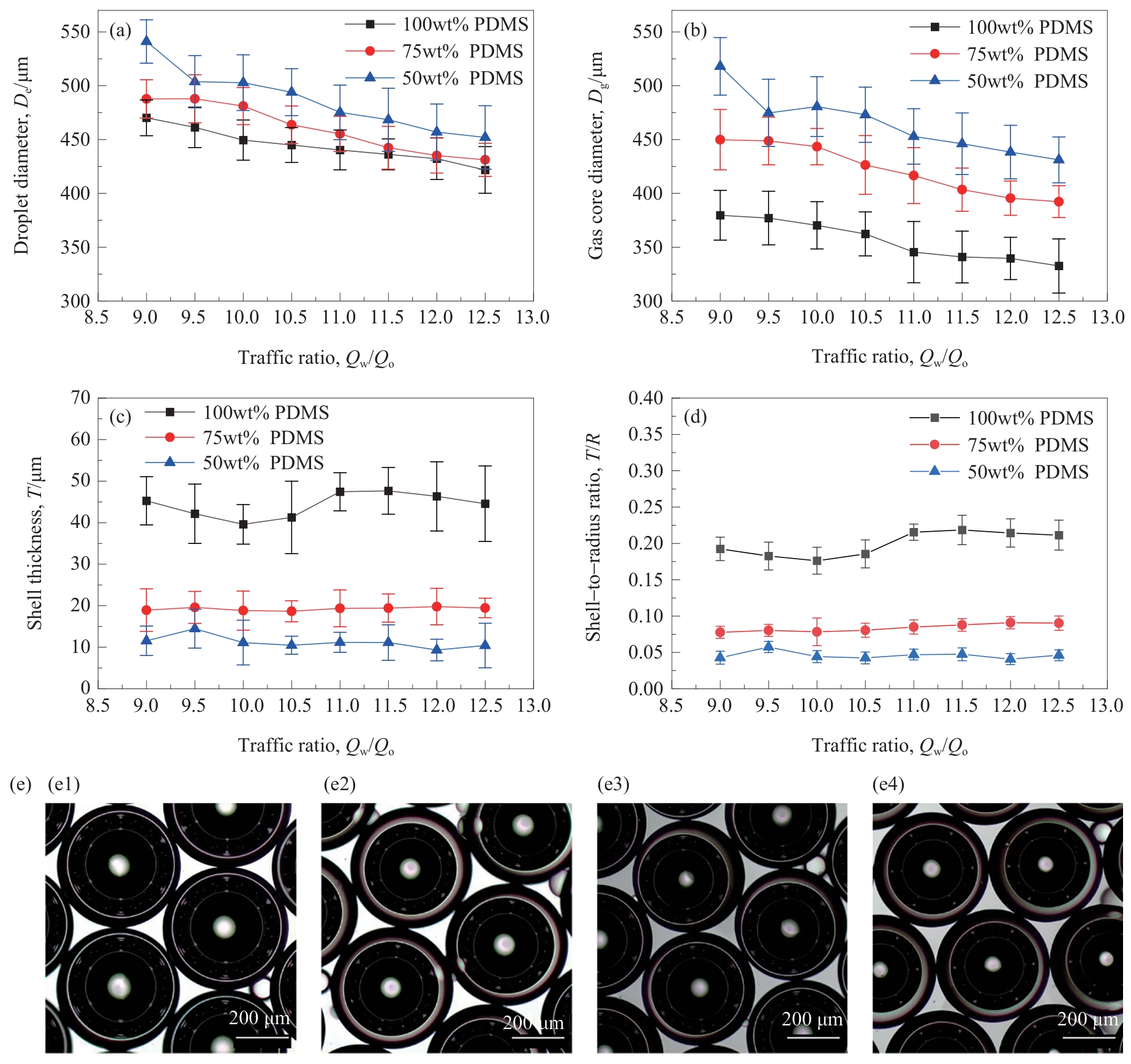
图3 G/O/W液滴不同黏度油相和Qw/Qo下液滴尺寸和形态图(油相流速固定为0.25 mL/h)[(a) 液滴尺寸数据;(b) 气核尺寸数据;(c) 壳厚尺寸数据;(d) 壳径比尺寸数据;(e) 不同流量比下使用100wt% PDMS油相生成的液滴光学显微照片:(e1) Qw/Qo=9.0, De=460 μm, Dg=410 μm; (e2) Qw/Qo=10.0, De=460 μm, Dg=360 μm; (e3) Qw/Qo=11.0, De=450 μm, Dg=360 μm; (e4) Qw/Qo=12.0, De=430 μm, Dg=340 μm]
Fig.3 Morphologies and size characteristics of G/O/W droplets under different oil phase viscosities and Qw/Qo (oil phase flow rate fixed at 0.25 mL/h) [(a) droplet diameter data; (b) gas core diameter data; (c) shell thickness data; (d) shell-to-radius ratio data; (e) optical micrographs of droplets generated using 100wt% PDMS oil phase at different traffic ratios: (e1) Qw/Qo=9.0, De=460 μm, Dg=410 μm; (e2) Qw/Qo=10.0, De=460 μm, Dg=360 μm; (e3) Qw/Qo=11.0, De=450 μm, Dg=360 μm; (e4) Qw/Qo=12.0, De=430 μm, Dg=340 μm]
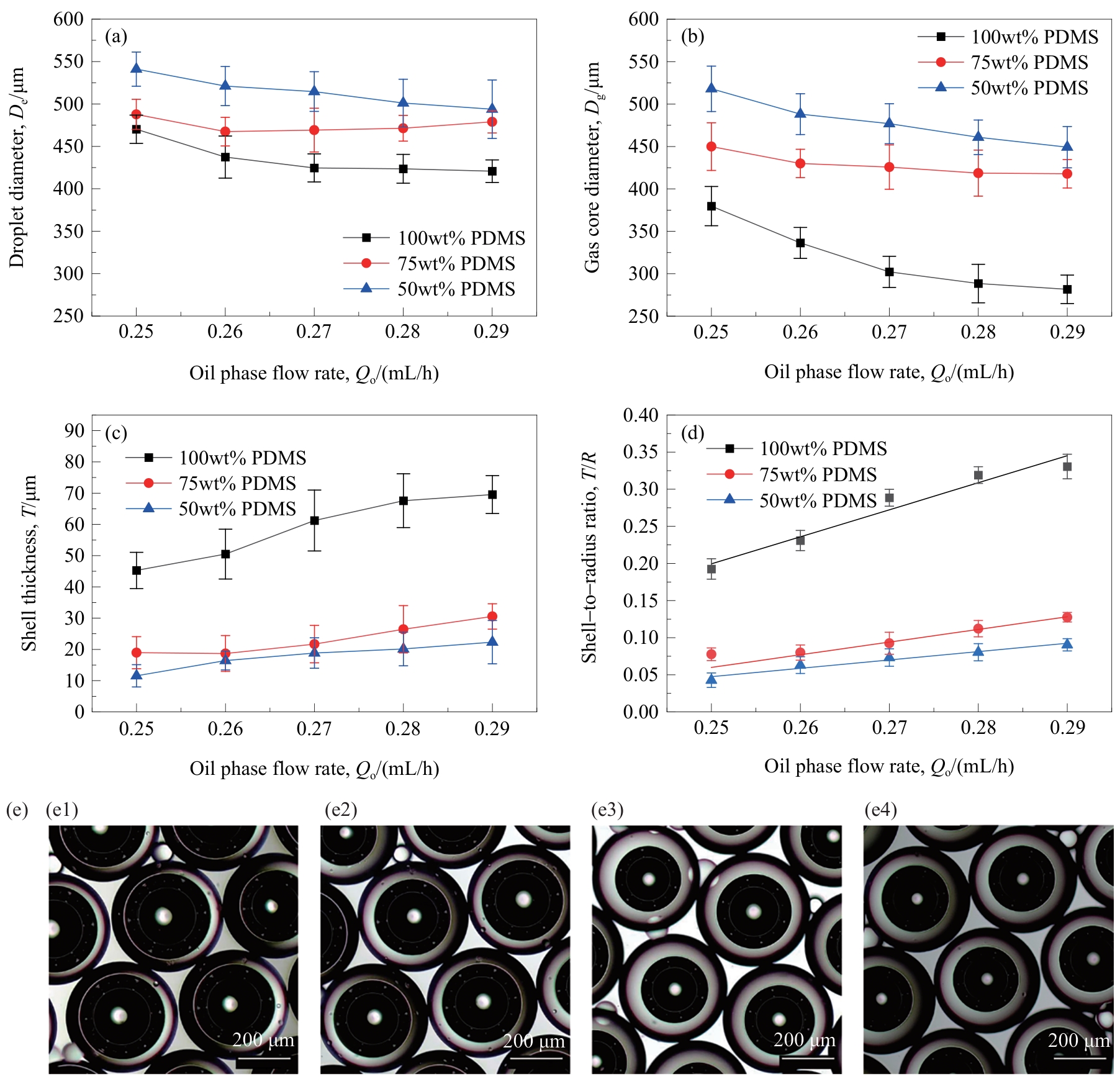
图4 G/O/W液滴不同黏度油相和Qo下液滴尺寸和形态图(水相流速固定为2.25 mL/h) [(a) 液滴尺寸数据;(b) 气核尺寸数据;(c) 壳厚尺寸数据;(d) 壳径比尺寸数据;(e) 不同油相流速下使用100wt% PDMS油相生成的液滴光学显微照片:(e1) Qo=0.26 mL/h, De=420 μm, Dg=320 μm; (e2) Qo=0.27 mL/h, De=425 μm, Dg=300 μm; (e3) Qo=0.28 mL/h, De=425 μm, Dg=260 μm; (e4) Qo=0.29 mL/h, De=400 μm, Dg=250 μm]
Fig.4 Morphologies and size characteristics of G/O/W droplets under different oil phase viscosities and oil phase flow rates (water phase flow rate fixed at 2.25 mL/h) [(a) droplet diameter data; (b) gas core diameter data; (c) shell thickness data; (d) shell-to-radius ratio data; (e) optical micrographs of droplets generated using 100wt% PDMS oil phase at different oil phase flow rates: (e1) Qo=0.26 mL/h, De=420 μm, Dg=320 μm; (e2) Qo=0.27 mL/h, De=425 μm, Dg=300 μm; (e3) Qo=0.28 mL/h, De=425 μm, Dg=260 μm; (e4) Qo=0.29 mL/h, De=400 μm, Dg=250 μm]
| Aqueous phase | 3wt% PVA | 3wt% PVA+0.10wt% SDS | 3wt% PVA+0.15wt% SDS | 3wt% PVA+0.20wt% SDS |
|---|---|---|---|---|
| μw/mPa·s | 14 | 37 | 50 | 60 |
表2 水相黏度
Table 2 Viscosity of the aqueous phase
| Aqueous phase | 3wt% PVA | 3wt% PVA+0.10wt% SDS | 3wt% PVA+0.15wt% SDS | 3wt% PVA+0.20wt% SDS |
|---|---|---|---|---|
| μw/mPa·s | 14 | 37 | 50 | 60 |
| Aqueous phase | 3wt% PVA | 3wt% PVA+0.10wt% SDS | 3wt% PVA+0.15wt% SDS | 3wt% PVA+0.20wt% SDS |
|---|---|---|---|---|
| γow/(mN/m) | 20 | 16 | 14 | 12.5 |
表3 75wt% PDMS油相与水相的界面张力
Table 3 Interfacial tension between the 75wt% PDMS oil phase and the aqueous phases
| Aqueous phase | 3wt% PVA | 3wt% PVA+0.10wt% SDS | 3wt% PVA+0.15wt% SDS | 3wt% PVA+0.20wt% SDS |
|---|---|---|---|---|
| γow/(mN/m) | 20 | 16 | 14 | 12.5 |

图5 G/O/W液滴不同SDS外相浓度和Qw/Qo下液滴尺寸和形态图(油相流速固定为0.25 mL/h) [(a) 液滴尺寸数据;(b) 气核尺寸数据;(c) 壳厚尺寸数据;(d) 壳径比尺寸数据;(e) 不同流量比下使用3wt% PVA+0.20wt% SDS水相生成的液滴光学显微照片:(e1) Qw/Qo=9.5, De=400 μm, Dg=325 μm; (e2) Qw/Qo=10.0, De=390 μm, Dg=300 μm; (e3) Qw/Qo=10.5, De=340 μm, Dg=235 μm; (e4) Qw/Qo=11.0, De=360 μm, Dg=230 μm]
Fig.5 Morphologies and size characteristics of G/O/W droplets under different outer-phase SDS concentrations and traffic ratios (Qw/Qo) (oil phase flow rate fixed at 0.25 mL/h) [(a) droplet diameter data; (b) gas core diameter data; (c) shell thickness data; (d) shell-to-radius ratio data; (e) optical micrographs of droplets generated using 3wt% PVA+0.20wt% SDS aqueous phase at different traffic ratios: (e1) Qw/Qo=9.5, De=400 μm, Dg=325 μm; (e2) Qw/Qo=10.0, De=390 μm, Dg=300 μm; (e3) Qw/Qo=10.5, De=340 μm, Dg=235 μm; (e4) Qw/Qo=11.0, De=360 μm, Dg=230 μm]

图6 G/O/W液滴不同SDS外相浓度和Qo下液滴尺寸和形态图(水相流速固定为2.25 mL/h) [(a) 液滴尺寸数据;(b) 气核尺寸数据;(c) 壳厚尺寸数据;(d) 壳径比尺寸数据;(e) 不同油相流速下使用3wt% PVA+0.20w% SDS水相生成的液滴光学显微照片:(e1) Qo=0.26 mL/h, De=390 μm, Dg=300 μm; (e2) Qo=0.27 mL/h, De=350 μm, Dg=255 μm; (e3) Qo=0.28 mL/h, De=340 μm, Dg=235 μm; (e4) Qo=0.29 mL/h, De=330 μm, Dg=225 μm]
Fig.6 Morphologies and size characteristics of G/O/W droplets under different outer-phase SDS concentrations and oil phase flow rates (water phase flow rate fixed at 2.25 mL/h) [(a) droplet diameter data; (b) gas core diameter data; (c) shell thickness data; (d) shell-to-radius ratio data; (e) optical micrographs of droplets generated using 3wt% PVA+0.20wt% SDS aqueous phase at different oil phase flow rates: (e1) Qo=0.26 mL/h, De=390 μm, Dg=300 μm; (e2) Qo=0.27 mL/h, De=350 μm, Dg=255 μm; (e3) Qo=0.28 mL/h, De=340 μm, Dg=235 μm; (e4) Qo=0.29 mL/h, De=330 μm, Dg=225 μm]
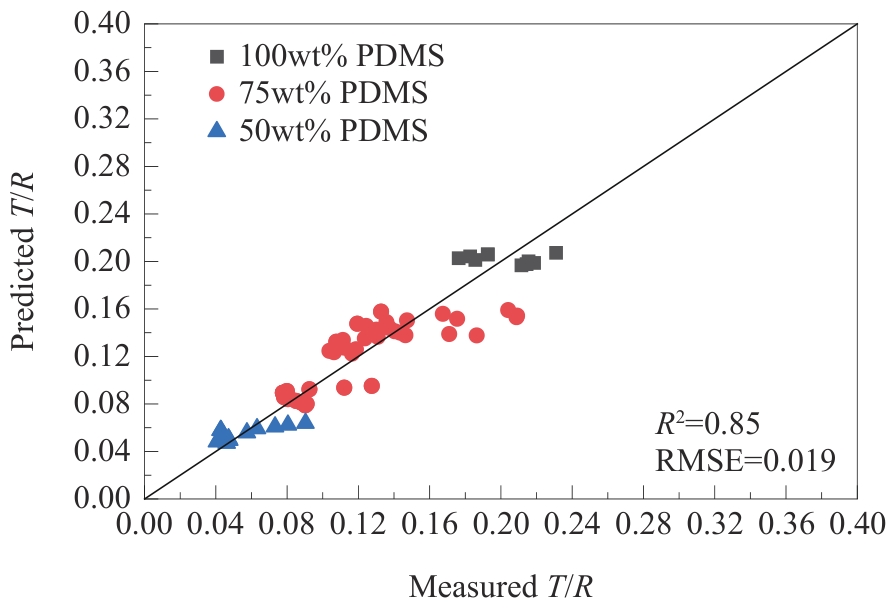
图7 预测与实测T/R的对比
Fig.7 Comparison between predicted and measured values of the shell-to-radius ratio (T/R)
| [1] | Choudhury N, Meghwal M, Das K. Microencapsulation: an overview on concepts, methods and applications [J]. Food Frontiers, 2021, 2(3): 327-344. |
| [2] | Silva B F B, Rodríguez-Abreu C, Vilanova N. Recent advances in multiple emulsions and their application as templates [J]. Current Opinion in Colloid & Interface Science, 2016, 25: 98-108. |
| [3] | Zhu J Y, He J Y, Zhou J, et al. Recent progress in microencapsulation technology and its applications in petroleum industry [J]. Journal of Molecular Liquids, 2024, 407: 125162. |
| [4] | Molley T G, Jiang S, Ong L, et al. Gas-modulating microcapsules for spatiotemporal control of hypoxia [J]. Proceedings of the National Academy of Sciences, 2023, 120(17): e2217557120. |
| [5] | Toprakcioglu Z, Hakala T A, Levin A, et al. Multi-scale microporous silica microcapsules from gas-in-water-in-oil emulsions [J]. Soft Matter, 2020, 16(13): 3082-3087. |
| [6] | Yoon D H, Hasegawa K, Kaneko Y, et al. Formation of polymeric hollow microcapsules and microlenses using gas-in-organic-in-water droplets [J]. Micromachines, 2015, 6(5): 622-633. |
| [7] | Chen R, Dong P F, Xu J H, et al. Controllable microfluidic production of gas-in-oil-in-water emulsions [J]. Lab on a Chip, 2012, 12(20): 3910-3916. |
| [8] | Duran M, Serrano A, Nikulin A, et al. Microcapsule production by droplet microfluidics: a review from the material science approach [J]. Materials & Design, 2022, 223: 111230. |
| [9] | Lobel B T, Baiocco D, Al-Sharabi M, et al. Current challenges in microcapsule designs and microencapsulation processes: a review [J]. ACS Applied Materials & Interfaces, 2024, 16(31): 40326-40355. |
| [10] | Datta S S, Abbaspourrad A, Amstad E, et al. Double emulsion templated solid microcapsules: mechanics and controlled release [J]. Advanced Materials, 2014, 26(14): 2205-2218. |
| [11] | Vladisavljević G T, Al Nuumani R, Nabavi S A. Microfluidic production of multiple emulsions [J]. Micromachines, 2017, 8(3): 75. |
| [12] | Yang L, Wang K, Mak S, et al. A novel microfluidic technology for the preparation of gas-in-oil-in-water emulsions [J]. Lab on a Chip, 2013, 13(17): 3351-3354. |
| [13] | Nekouei M, Vanapalli S A. Volume-of-fluid simulations in microfluidic T-junction devices: influence of viscosity ratio on droplet size [J]. Physics of Fluids, 2017, 29(3): 032007. |
| [14] | Utada A S, Lorenceau E, Link D R, et al. Monodisperse double emulsions generated from a microcapillary device [J]. Science, 2005, 308(5721): 537-541. |
| [15] | Yang S H, Song W L, Fan L L, et al. Microfluidic fabrication of monodisperse microcapsules with gas cores [J]. Lab on a Chip, 2024, 24: 3556-3567. |
| [16] | Anna S L. Droplets and bubbles in microfluidic devices [J]. Annual Review of Fluid Mechanics, 2016, 48: 285-309. |
| [17] | Dai Y C, Cha H T, Nguyen N K, et al. Dynamic behaviours of monodisperse double emulsion formation in a tri-axial capillary device [J]. Micromachines, 2022, 13(11): 1877. |
| [18] | Hu C Y, Jiang F, Yan J. Formation of double emulsion droplets in flow-focusing microchips: a numerical parametric study [J]. Journal of Flow Chemistry, 2024, 14: 641-653. |
| [19] | Calhoun S G K, Brower K K, Chandran Suja V, et al. Systematic characterization of effect of flow rates and buffer compositions on double emulsion droplet volumes and stability [J]. Lab on a Chip, 2022, 22: 2315-2330. |
| [20] | Cleve S, Lassus A, Diddens C, et al. Microbubble formation by flow focusing: role of gas and liquid properties, and channel geometry [J]. Journal of Fluid Mechanics, 2023, 972: A27. |
| [21] | He C X, Liu X Y, Dong Y P, et al. Droplet formation in a step-emulsification microdevice: effect of fluid's viscosity [J]. Chemical Engineering and Processing: Process Intensification, 2023, 185: 109309. |
| [22] | Wang S T, Wang H, Wu Y T, et al. Numerical study of double emulsion generation in a flow-focusing microchannel by multiple-relaxation-time lattice Boltzmann method [J]. Physics of Fluids, 2024, 36(3): 032010. |
| [23] | Deng B X, Schroën K. Dynamic interfacial effects investigated by microfluidics: formation and stability of droplets and bubbles [J]. Current Opinion in Colloid & Interface Science, 2024, 73: 101826. |
| [24] | Huang B, Ge X J, Rubinstein B Y, et al. Gas-assisted microfluidic step-emulsification for generating hollow-core double emulsions [J]. Microsystems & Nanoengineering, 2023, 9: 38. |
| [25] | Wang J W, Hahn S, Amstad E, et al. Tailored double emulsions made simple [J]. Advanced Materials, 2022, 34(5): 2107338. |
| [26] | Xie B S, Jiang F, Lin H J, et al. Numerical investigation of the effect of microfluidic flow parameters and physical properties on double emulsion droplet forming [J]. Meccanica, 2024, 59: 157-168. |
| [27] | Lee D, Shen A Q. Interfacial tension measurements in microfluidic quasi-static extensional flows [J]. Micromachines, 2021, 12(3): 272. |
| [28] | Brosseau Q, Vrignon J, Baret J C. Microfluidic dynamic interfacial tensiometry (μDIT) [J]. Soft Matter, 2014, 10(17): 3066-3076. |
| [1] | 尹然 吴艳 崔兆雪 仝立宁 王晗 李彬 孙治谦 王振波. 电场和物性参数对液滴-界面聚并行为的影响[J]. 过程工程学报, 2025, 25(6): 598-608. |
| [2] | 刘晓杰 徐顺生 孔润娟 刘建波. 基于后燃烧技术的CFB锅炉低氮燃烧数值模拟[J]. 过程工程学报, 2024, 24(8): 914-925. |
| [3] | 雷杰 王昱 马明 李培生 张莹. 基于FTM方法的双气泡融合特性模拟[J]. 过程工程学报, 2019, 19(2): 263-270. |
| [4] | 鲍允州 吴忱韩 张莹. 流经突然扩张的微通道的单气泡界面形态演变的数值模拟[J]. 过程工程学报, 2018, 18(6): 1178-1186. |
| [5] | 程娜 周梅芳 陈鹏宇 李春忠 姜海波 张玲. 碳化法可控制备纳米碳酸钙研究进展[J]. 过程工程学报, 2017, 17(2): 412-419. |
| [6] | 胡坤 艾志久 付必伟 李杰 李振北. T型管油水分离特性数值模拟 [J]. , 2017, 17(1): 29-34. |
| [7] | 焦方冉 李洪钟 朱庆山. 背压对U阀排料特性的影响[J]. 过程工程学报, 2016, 16(4): 571-576. |
| [8] | 程世萌 邓朝俊 何雄元 徐博雅 黄卫星. 微液滴制备及其在静止流体中的浮升过程[J]. 过程工程学报, 2016, 16(3): 388-393. |
| [9] | 郑晓野 蒲文灏 岳晨 何伟峰 韩东. 采用改进的曳力模型模拟2D鼓泡流化床的流化特性[J]. 过程工程学报, 2015, 15(5): 737-743. |
| [10] | 鲁峰 温良英 王海鹏 梁海龙 李元坤. 沸腾炉炉底形状对气固两相流动特性的影响[J]. , 2015, 15(1): 23-28. |
| [11] | 刘双 贺铸 王强 夏添 李宝宽. 电渣重熔过程中熔滴形成与滴落过程的数值模拟[J]. , 2014, 14(5): 737-743. |
| [12] | 张东堂 程昌 汪夏燕 夏定国. 微流控法合成石墨烯负载的PtNi燃料电池阴极催化剂及其性能[J]. , 2013, 13(4): 698-703. |
| [13] | 王淋淋 尤学一. 波形隔板对平板式生物反应器传质及混合性能的影响[J]. , 2012, 12(5): 748-753. |
| [14] | 丁锐 高飞 苏志国 王平 马光辉 张松平. 选择性紫外曝光法修饰微流控芯片用于制备高度均一的单乳液和复乳液[J]. , 2011, 11(3): 461-467. |
| [15] | 李昱喆 齐祥明 刘天中 陈昱. 带波纹隔板的平板式光生物反应器流动特性[J]. , 2010, 10(5): 849-855. |
| 阅读次数 | ||||||
|
全文 |
|
|||||
|
摘要 |
|
|||||

